
Introduction
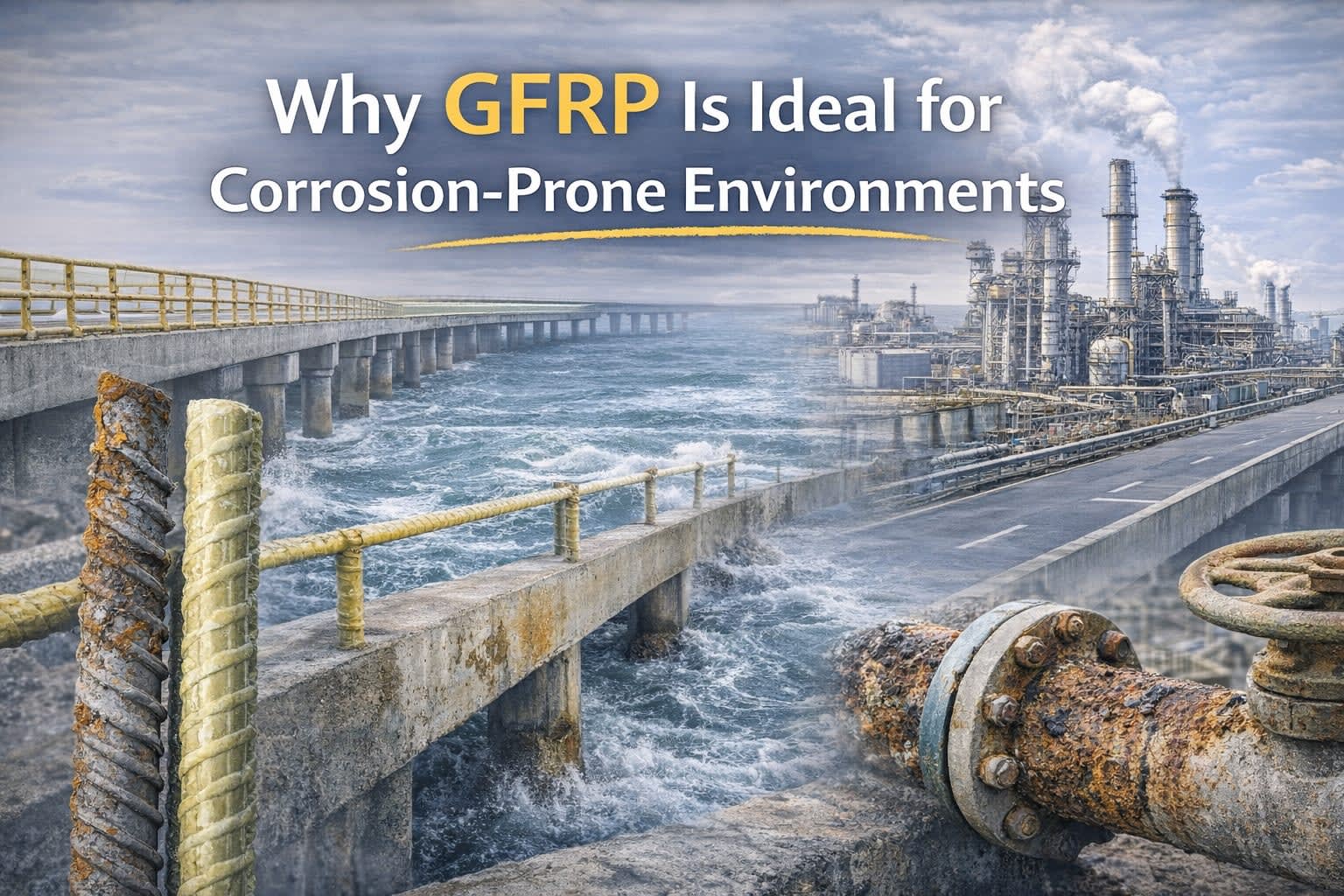
Corrosion is one of the most destructive forces affecting reinforced concrete structures worldwide. From coastal bridges and marine jetties to chemical plants and wastewater facilities, corrosion silently weakens steel reinforcement, leading to structural deterioration, costly repairs, and reduced service life.
For decades, engineers have searched for a durable alternative to traditional steel rebar. Today, Glass Fibre Reinforced Polymer (GFRP) has emerged as the most reliable solution for aggressive environments.
At Rebarx, we manufacture high-performance glass fibre reinforcement bars specifically engineered to withstand corrosion-prone conditions. This article explains why GFRP is the ideal reinforcement material where durability is non-negotiable.
Understanding the Problem: Why Steel Fails in Corrosive Conditions
Steel reinforcement corrodes when exposed to:
- Chlorides (seawater, de-icing salts)
- Sulfates (soil and groundwater)
- Industrial chemicals
- High humidity and moisture
- Carbonation in concrete
When steel corrodes, it expands. This expansion causes:
- Cracking in concrete
- Spalling and delamination
- Reduced structural strength
- Increased maintenance costs
Over time, corrosion compromises the structural integrity of bridges, flyovers, marine structures, and industrial facilities.
This is precisely where GFRP changes the game.
What Makes GFRP Different?
Unlike steel, GFRP does not contain iron. It is made from high-strength glass fibers embedded in a polymer resin matrix. Because it is non-metallic, it does not rust — ever.
This fundamental difference gives glass fibre reinforcement bars a decisive advantage in aggressive environments.
1. Complete Corrosion Resistance
The most significant advantage of GFRP is its immunity to corrosion.
- No rust formation
- No expansion due to oxidation
- No cracking caused by internal pressure
- No deterioration from saltwater exposure
In marine environments, where chloride attack rapidly destroys steel, GFRP maintains structural integrity for decades.
For infrastructure exposed to chemical or saline conditions, leading GFRP rebar manufacturers recommend GFRP as a long-term solution.
2. Superior Durability in Marine and Coastal Structures
Coastal regions are highly aggressive due to:
- Salt-laden air
- Continuous humidity
- Direct seawater contact
Steel reinforcement in such environments requires protective coatings, cathodic protection, or frequent maintenance. Even then, long-term corrosion remains a concern.
In contrast, glass fibre reinforcement bars:
- Are unaffected by chlorides
- Do not require protective coatings
- Reduce lifecycle maintenance costs
- Extend service life significantly
This makes GFRP ideal for:
- Sea walls
- Jetties and ports
- Coastal bridges
- Offshore platforms
3. Chemical Resistance in Industrial Environments
Chemical plants and wastewater treatment facilities expose concrete structures to:
- Acids
- Alkalis
- Industrial effluents
- Sulfates
Steel corrodes rapidly under such chemical exposure. GFRP, however, demonstrates excellent resistance to chemical attack, depending on the resin system used.
As experienced GFRP rebar manufacturers, Rebarx designs reinforcement bars suitable for chemically aggressive environments, ensuring long-term performance without degradation.
4. Extended Service Life and Reduced Lifecycle Costs
While initial material cost is one factor in infrastructure planning, lifecycle cost is far more important.
Steel-reinforced structures often require:
- Periodic inspection
- Concrete repairs
- Rebar replacement
- Traffic disruption during maintenance
GFRP eliminates corrosion-related maintenance, leading to:
- Lower repair frequency
- Reduced downtime
- Lower total lifecycle cost
- Greater return on investment
For public infrastructure projects, this translates into long-term economic efficiency.
5. High Strength-to-Weight Ratio
Corrosion resistance alone is not enough — reinforcement must also provide structural strength.
GFRP offers:
- High tensile strength (often higher than steel)
- Lightweight properties (up to 75% lighter than steel)
- Easier transportation and handling
- Reduced structural dead load
In corrosion-prone environments, combining strength with durability gives engineers a superior solution.
6. Non-Conductive and Non-Magnetic Properties
In environments such as:
- Power plants
- Electrical substations
- MRI facilities
- Industrial control rooms
Steel’s conductivity and magnetic interference can create complications.
GFRP is:
- Electrically non-conductive
- Non-magnetic
- Transparent to electromagnetic fields
These properties make it ideal for specialized infrastructure where electrical interference must be avoided.
7. Sustainability and Environmental Benefits
Corrosion-related repairs consume enormous resources globally. By eliminating corrosion, GFRP contributes to:
- Reduced material replacement
- Lower carbon footprint
- Longer infrastructure lifespan
- Sustainable construction practices
Using glass fibre reinforcement bars aligns with modern infrastructure sustainability goals.
Applications in Corrosion-Prone Environments
GFRP is widely used in:
- Coastal bridges
- Marine structures
- Chemical plants
- Wastewater treatment plants
- Underground tunnels
- Foundations exposed to aggressive soils
Forward-thinking engineers increasingly consult experienced GFRP rebar manufacturers to ensure project durability in high-risk environments.
Why Choose Rebarx?
At Rebarx, we are committed to delivering high-performance GFRP solutions engineered for aggressive environments.
Our strengths include:
- Precision manufacturing technology
- Consistent tensile strength performance
- Advanced quality testing
- Customized sizing options
- Reliable supply across India
As trusted GFRP rebar manufacturers, we ensure that every batch of glass fibre reinforcement bars meets strict durability and performance standards.
When corrosion resistance is critical, Rebarx delivers uncompromising quality.
Conclusion
Corrosion is one of the leading causes of structural failure worldwide. Traditional steel reinforcement, while strong, is vulnerable in aggressive environments. For coastal, marine, industrial, and chemically exposed infrastructure, the risks of corrosion are too significant to ignore.
GFRP offers a corrosion-proof alternative that combines durability, strength, lightweight performance, and long-term cost efficiency.
For infrastructure projects where longevity and performance matter most, Rebarx provides reliable, high-quality glass fibre reinforcement bars designed to withstand even the harshest environments.
Frequently Asked Questions (FAQs)
1. Does GFRP eliminate corrosion?
Yes. Since GFRP is non-metallic, it does not rust or corrode like steel.
2. Where is GFRP most beneficial?
It is ideal for coastal areas, chemical plants, wastewater facilities, and marine infrastructure.
3. Is GFRP strong enough to replace steel?
Yes. GFRP offers high tensile strength and excellent structural performance.
4. Are glass fibre reinforcement bars cost-effective?
They significantly reduce lifecycle maintenance costs, making them economically efficient in the long term.
5. Why choose Rebarx as your GFRP supplier?
Rebarx combines advanced manufacturing, strict quality standards, and reliable supply to deliver high-performance reinforcement solutions.