
Introduction
Coastal and marine infrastructure faces some of the harshest environmental conditions in the construction industry. Saltwater exposure, high humidity, tidal fluctuations, and chloride penetration create a highly aggressive environment for reinforced concrete structures.
Traditional steel reinforcement, while strong, is extremely vulnerable to corrosion in such conditions. Over time, corrosion leads to cracking, spalling, structural weakening, and expensive rehabilitation.
This is why engineers and infrastructure planners increasingly rely on GFRP rebar manufacturers to supply reinforcement solutions designed specifically for marine durability.
Glass Fiber Reinforced Polymer (GFRP) rebar has transformed coastal construction by offering corrosion-free performance and extended service life.
The Core Challenge: Corrosion in Marine Environments
Saltwater contains high concentrations of chlorides. When chlorides penetrate concrete and reach steel reinforcement, corrosion begins.
Corroding steel:
- Expands internally
- Causes concrete cracking
- Reduces structural strength
- Leads to frequent maintenance
- Increases lifecycle costs
In marine projects such as:
- Jetties
- Piers
- Sea walls
- Coastal bridges
- Offshore platforms
Corrosion is not a possibility — it is inevitable with steel.
This reality has shifted the focus toward GFRP reinforcement.
What Makes GFRP Ideal for Coastal Infrastructure?
1. 100% Corrosion Resistance
GFRP rebar does not contain iron, meaning it does not rust.
Unlike steel:
- No oxidation occurs
- No expansion due to corrosion
- No internal cracking pressure
- No chloride attack damage
For marine environments, this property alone makes GFRP the superior solution.
This is why coastal developers actively seek experienced GFRP rebar manufacturers for long-term structural reliability.
2. Extended Service Life
Marine infrastructure is designed for decades of service.
Steel-reinforced marine structures often require:
- Protective coatings
- Cathodic protection
- Frequent inspections
- Major rehabilitation within 20–30 years
GFRP reinforcement significantly extends structural lifespan, often aligning with 75–100 year design goals.
Longer lifespan means:
- Lower maintenance budgets
- Fewer shutdowns
- Improved asset value
3. Reduced Lifecycle Cost
Although steel may appear economical initially, corrosion-related repairs dramatically increase long-term costs.
Marine repairs involve:
- Diving inspections
- Concrete patchwork
- Structural retrofitting
- Operational downtime
GFRP reduces or eliminates corrosion-related maintenance, making it economically advantageous over the project lifecycle.
Infrastructure authorities increasingly evaluate total lifecycle cost — not just initial material price — when selecting reinforcement.
4. High Strength-to-Weight Ratio
GFRP offers high tensile strength while being significantly lighter than steel.
Benefits include:
- Easier transportation to remote coastal sites
- Reduced handling effort
- Faster installation
- Lower structural dead load
In large marine projects, weight efficiency contributes to overall structural optimization.
5. Chemical Resistance Beyond Saltwater
Marine environments are not limited to salt exposure. Ports and harbors often face:
- Industrial discharge
- Chemical pollutants
- Sulfate exposure
GFRP performs exceptionally well in chemically aggressive environments, making it ideal for industrial coastal zones.
6. Non-Conductive and Non-Magnetic Properties
In marine and offshore energy projects, electrical interference can be a concern.
GFRP is:
- Electrically non-conductive
- Non-magnetic
- Transparent to electromagnetic fields
This makes it suitable for:
- Offshore wind farms
- Subsea cable structures
- Port electrical installations
Applications in Coastal and Marine Projects
GFRP rebar is increasingly used in:
- Sea walls
- Breakwaters
- Jetties and docks
- Coastal highways
- Port infrastructure
- Bridge decks near coastlines
- Offshore oil and gas platforms
The shift toward composite reinforcement is no longer experimental — it is strategic.
Why Project Owners Prefer Specialized GFRP Rebar Manufacturers
Selecting the right manufacturer is critical in marine construction.
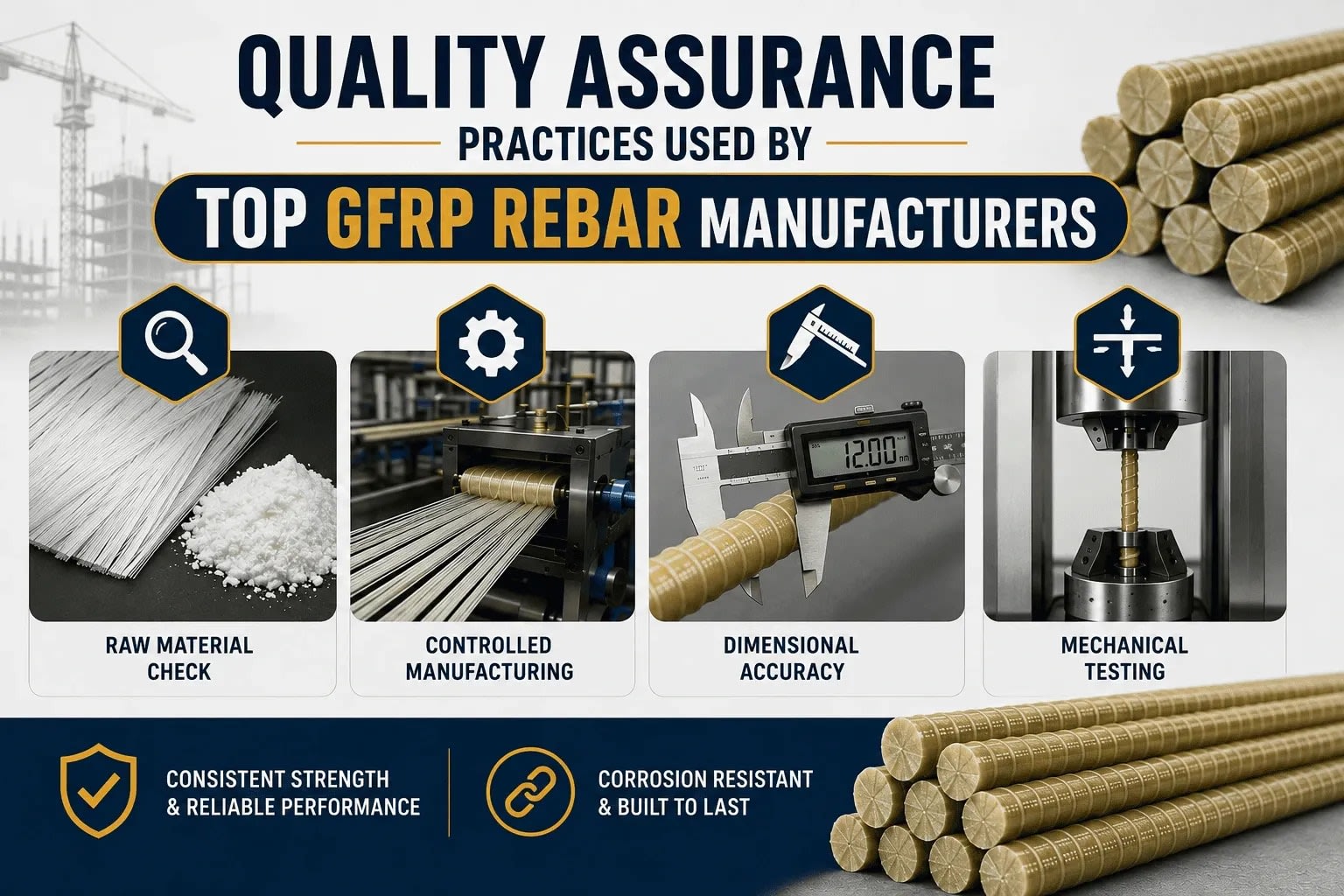
Experienced GFRP rebar manufacturers provide:
- Consistent tensile strength quality
- Advanced resin systems for chemical resistance
- Custom bar sizing
- Technical guidance for design adaptation
- Compliance with international standards
Marine projects demand reliability. Partnering with established manufacturers ensures product consistency and long-term performance.
Sustainability Advantages in Coastal Regions
Marine ecosystems are environmentally sensitive.
Using corrosion-resistant reinforcement:
- Reduces repair-related waste
- Minimizes material replacement
- Lowers carbon emissions over time
- Protects surrounding ecosystems from structural degradation
Sustainable coastal infrastructure increasingly relies on durable reinforcement solutions like GFRP.
Future of Marine Infrastructure
With rising sea levels, increased coastal development, and expanding port infrastructure, durability is becoming more critical than ever.
The global construction industry is moving toward materials that:
- Withstand aggressive environments
- Require minimal maintenance
- Offer predictable long-term performance
GFRP rebar meets all these criteria, making it a future-ready reinforcement solution.
Conclusion
Coastal and marine projects operate in the most corrosion-prone environments in construction. Traditional steel reinforcement struggles under continuous chloride exposure, leading to structural deterioration and escalating maintenance costs.
GFRP rebar offers a corrosion-proof, durable, and cost-efficient alternative. Its lightweight nature, chemical resistance, and extended service life make it the preferred choice for marine infrastructure.
As durability standards continue to rise, project developers increasingly rely on trusted GFRP rebar manufacturers to deliver reinforcement solutions capable of performing in the harshest conditions.
For marine construction, the choice is no longer just about strength — it is about longevity and reliability.