
Introduction
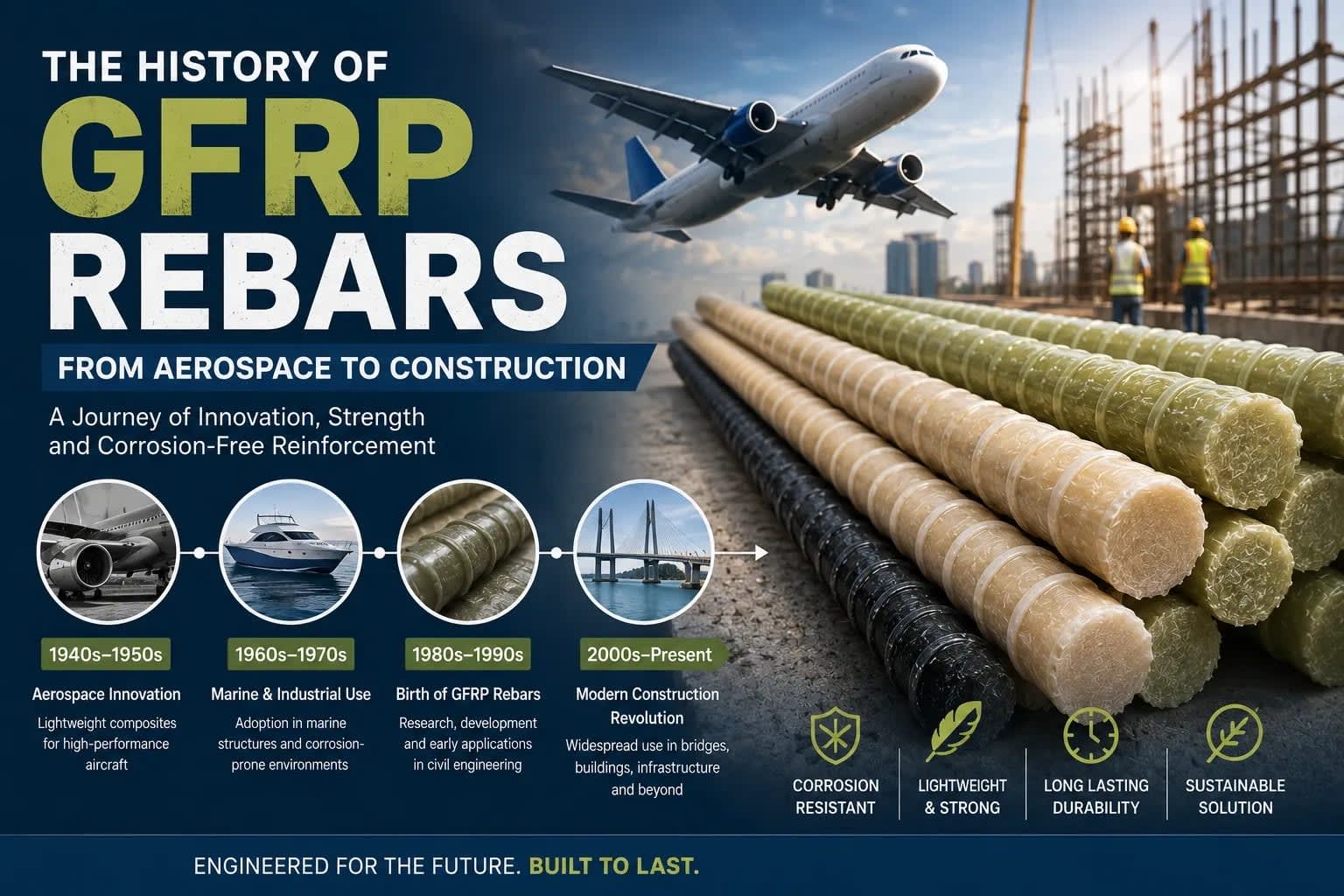
Glass Fiber Reinforced Polymer, commonly known as GFRP, has emerged as one of the most innovative materials in the modern construction industry. Today, GFRP rebars are widely recognized for their corrosion resistance, lightweight structure, and long-lasting durability. However, the journey of GFRP rebars did not begin in construction. Their origins can be traced back to the aerospace and military industries, where engineers were searching for stronger and lighter materials capable of performing under extreme conditions.
Over the decades, GFRP technology has evolved significantly and gradually entered the world of civil engineering and infrastructure development. What was once considered an advanced aerospace material is now transforming bridges, highways, marine structures, and commercial buildings across the globe.
This blog explores the fascinating history of GFRP rebars and how they evolved from aerospace innovation to becoming a revolutionary solution in modern construction.
The Early Origins of Fiberglass Technology
The history of GFRP rebars begins with the development of fiberglass technology during the early twentieth century. Scientists discovered that extremely thin glass fibers could be woven together and combined with resin materials to create lightweight composite products with remarkable strength.
During the 1930s, fiberglass started gaining popularity because of its resistance to moisture, chemicals, and heat. At first, it was mainly used for insulation and industrial products. However, researchers soon realized that fiberglass could also provide structural strength when reinforced with polymer resin systems.
This discovery laid the foundation for the development of Glass Fiber Reinforced Polymer composites, which would later evolve into modern GFRP rebars.
The Role of Aerospace in GFRP Development
The aerospace industry played a major role in the advancement of composite materials. During World War II and the years that followed, aircraft manufacturers needed materials that were both lightweight and durable. Reducing aircraft weight was essential for improving speed, fuel efficiency, and overall performance.
Traditional materials such as steel were strong but extremely heavy. Engineers began experimenting with fiberglass-reinforced composites because they offered high strength while significantly reducing overall weight.
By the 1940s and 1950s, GFRP composites were being used in aircraft interiors, radar systems, structural panels, and other aerospace components. These materials proved highly effective because they could withstand challenging environmental conditions without corroding.
The aerospace industry’s investment in composite research accelerated the development of stronger resin systems, advanced fiber technology, and improved manufacturing methods. These innovations later became crucial for the evolution of GFRP rebars.
Expansion into Marine and Industrial Applications
Following the success of GFRP materials in aerospace, other industries began exploring their potential. The marine sector quickly adopted fiberglass composites because traditional metal components often suffered severe corrosion when exposed to seawater.
Boat manufacturers discovered that GFRP materials provided excellent durability while remaining lightweight and easy to shape. This led to widespread use of fiberglass composites in ships, docks, offshore structures, and marine equipment.
Industrial facilities also started using GFRP products in chemical plants, cooling towers, and water treatment systems where corrosion resistance was essential. These applications demonstrated the long-term durability of composite materials in highly aggressive environments.
The growing success of GFRP in these industries helped engineers realize that the same technology could potentially solve major problems in construction and infrastructure.
The Construction Industry’s Corrosion Problem
For decades, steel reinforcement has been the standard material used in concrete structures. While steel offered excellent strength, it also came with a serious limitation. When exposed to moisture, chemicals, or saltwater, steel begins to rust and corrode.
Corrosion weakened concrete structures from the inside and often resulted in expensive repairs, reduced structural life, and safety concerns. Bridges, highways, parking structures, and marine infrastructure were particularly vulnerable to this issue.
By the 1960s and 1970s, engineers started searching for alternatives that could reinforce without the risk of corrosion. This search led researchers to explore the use of in concrete reinforcement systems.
The Birth of GFRP Rebars
The idea of using GFRP as reinforcement for concrete marked a breakthrough in construction technology. Engineers recognized that GFRP rebars offered several advantages over traditional steel reinforcement.
Unlike steel, GFRP rebars do not rust when exposed to water, salt, or chemicals. They also provided high tensile strength while being significantly lighter than steel. These characteristics made them ideal for structures exposed to harsh environmental conditions.
Early GFRP rebars were primarily used in experimental infrastructure projects and specialized applications. Although adoption was initially slow, the results were highly promising. Structures reinforced with GFRP demonstrated impressive durability and lower maintenance requirements.
This period marked the beginning of GFRP rebars as a serious alternative to traditional steel reinforcement.
Technological Advancements in the 1980s
The 1980s brought major improvements in GFRP manufacturing technology. Earlier production methods often resulted in inconsistent quality, which limited large-scale adoption. However, advancements in pultrusion technology transformed the industry.
Pultrusion allowed manufacturers to produce continuous GFRP rebars with consistent strength, improved surface bonding, and better dimensional accuracy. This process significantly improved product reliability and performance.
At the same time, resin technology also evolved. New resin systems improved chemical resistance, thermal stability, and long-term durability. These advancements helped increase confidence in the structural capabilities of GFRP rebars.
As manufacturing processes improved, GFRP rebars became more commercially viable for infrastructure projects.
Research and Standardization During the 1990s
The 1990s represented a crucial period for the acceptance of GFRP rebars in civil engineering. Universities, government agencies, and research organizations conducted extensive testing to evaluate the structural performance of GFRP reinforcement systems.
Studies confirmed that GFRP rebars offered excellent tensile strength, corrosion resistance, and long-term durability. Researchers also examined their behavior under extreme weather conditions, heavy loads, and seismic activity.
The positive results encouraged engineering authorities to develop official standards and design guidelines for GFRP applications. The introduction of these standards played a major role in increasing industry confidence and promoting wider adoption.
As awareness grew, more infrastructure projects began incorporating GFRP rebars into their designs.
The Rise of GFRP Rebars in Modern Infrastructure
During the early twenty-first century, GFRP rebars gained widespread recognition in the construction industry. Governments and infrastructure developers are increasingly focused on building structures with longer service lives and lower maintenance costs.
Traditional steel-reinforced structures often required costly repairs due to corrosion-related damage. In contrast, GFRP-reinforced structures demonstrated exceptional durability even in coastal, marine, and industrial environments.
Today, GFRP rebars are widely used in bridges, highways, tunnels, seawalls, parking garages, water treatment plants, and marine structures. Their lightweight nature also simplifies transportation and installation, improving construction efficiency.
The growing demand for sustainable infrastructure has further accelerated the adoption of GFRP technology worldwide.
Why GFRP Rebars Are Considered a Better Long-Term Investment
One of the biggest reasons behind the rising popularity of GFRP rebars is their long-term economic advantage. While initial material costs may differ from traditional steel, the overall lifecycle cost of GFRP structures is often significantly lower.
Because GFRP rebars do not corrode, structures require fewer repairs and less maintenance over time. This leads to substantial savings in maintenance expenses, labor costs, and structural rehabilitation.
Infrastructure owners and developers now increasingly focus on lifecycle performance rather than only initial construction costs. As a result, GFRP rebars are often viewed as a smarter and more sustainable long-term investment compared to steel reinforcement.
Modern Innovations in GFRP Rebar Technology
Modern GFRP rebars are far more advanced than the early versions developed decades ago. Manufacturers now use sophisticated resin systems and precision manufacturing techniques to improve product performance.
Advanced surface treatments enhance the bond between GFRP rebars and concrete, while automated production systems ensure consistent quality and strength. Engineers are also developing hybrid composite systems that further improve structural performance and flexibility.
Digital design technologies such as Building Information Modeling and structural simulation software are helping optimize the use of GFRP reinforcement in modern infrastructure projects.
These innovations continue to expand the capabilities and applications of GFRP rebars across industries.
The Future of GFRP Rebars
The future of GFRP rebars appears extremely promising as infrastructure demands continue to grow worldwide. Rapid urbanization, climate challenges, and aging infrastructure are increasing the need for durable and corrosion-resistant construction materials.
Future advancements are expected to focus on improving sustainability, recyclability, and structural efficiency. Researchers are also exploring stronger fiber technologies and environmentally friendly resin systems to further enhance performance.
As governments and developers prioritize long-lasting infrastructure solutions, GFRP rebars are expected to play an even greater role in modern construction and civil engineering.
Conclusion
The history of GFRP rebars is a remarkable journey of innovation and engineering progress. What began as an aerospace material designed for lightweight performance eventually evolved into one of the most advanced reinforcement solutions in the construction industry.
From aircraft components and marine structures to bridges and highways, GFRP technology has consistently demonstrated its ability to solve critical durability challenges. Its corrosion resistance, lightweight properties, and long-term cost efficiency have made it an increasingly preferred alternative to traditional steel reinforcement.
As technology continues to evolve, GFRP rebars are expected to become even more important in the development of sustainable and resilient infrastructure around the world.
FAQs
What are GFRP rebars?
GFRP rebars are reinforcement bars made from glass fibers combined with polymer resin. They are used as an alternative to traditional steel reinforcement in concrete structures.
Why were GFRP materials first used in aerospace?
The aerospace industry needed lightweight yet strong materials that could improve aircraft performance and resist corrosion.
When did GFRP rebars enter the construction industry?
GFRP rebars started gaining attention in construction during the 1960s and 1970s as engineers searched for corrosion-resistant reinforcement materials.
Why are GFRP rebars better than steel in some applications?
GFRP rebars do not rust or corrode, making them highly suitable for coastal, marine, and chemical-exposed environments.
What is the future of GFRP rebars?
The future of GFRP rebars includes wider use in sustainable infrastructure, smart construction systems, and long-lasting civil engineering projects.