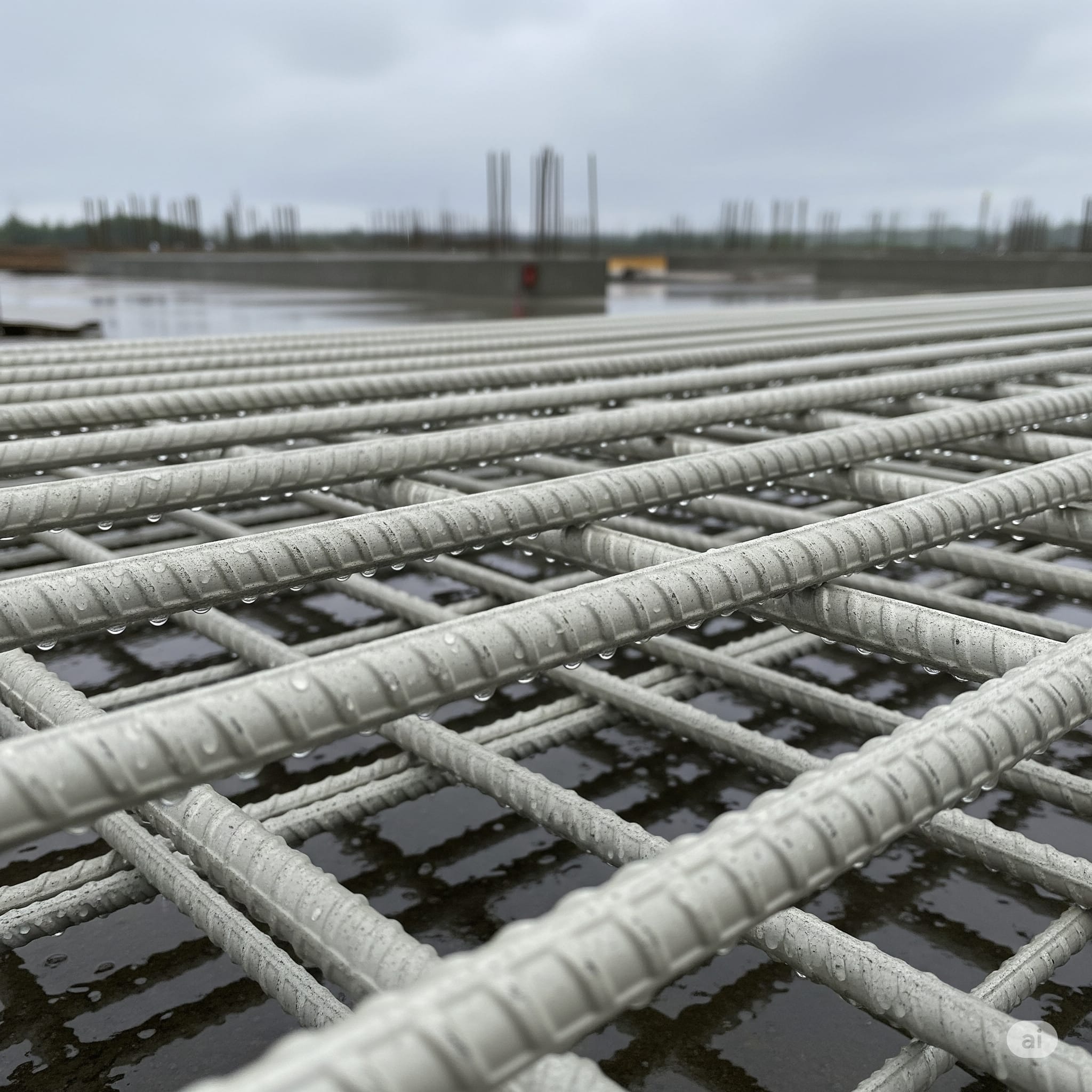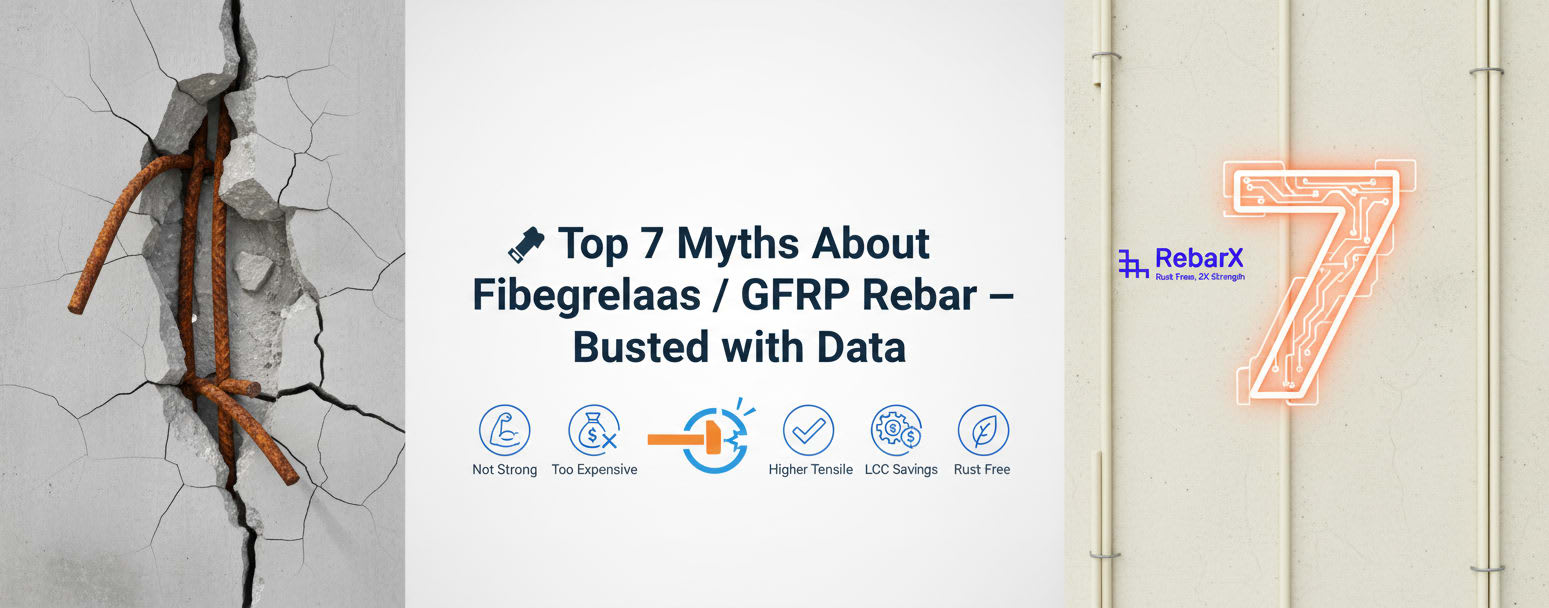
For years, steel has dominated construction. But as corrosion eats away bridges, ports, and coastal projects, GFRP (Glass Fiber Reinforced Polymer) rebar is stepping into the spotlight.Still, many decision-makers hesitate — because of old myths that simply aren’t true anymore.
Let’s bust the 7 biggest ones 👇
🧩 Myth 1: GFRP rebar is not as strong as steel
Fact: GFRP has 2x the tensile strength of steel.
- GFRP ≈ 1000 MPa
- Steel ≈ 500 MPaYes, its modulus (stiffness) is lower, but in reinforced concrete, stiffness comes from concrete + rebar together.When designed correctly (using IS 18256 or ACI 440.1R), GFRP structures perform equally or better than steel ones.
📊 Data:
ACI 440.1R-15 shows average GFRP tensile strength of 800–1200 MPa depending on fiber grade.
⚙️ Myth 2: GFRP rebar can’t handle high temperatures
Fact: Modern vinyl ester resin systems used in RebarX rebars can handle up to 120°C continuously — well above typical concrete service temperatures.
📊 Data:
ASTM D648 (Heat Deflection Temperature): 110–130°C for high-grade vinyl ester systems.
🌧️ Myth 3: It’s too fragile and breaks easily
Fact: GFRP doesn’t corrode, dent, or rust — and while it’s lightweight, it’s tougher than it looks.
- It’s impact-tested under ASTM D2584.
- RebarX bars are field-tested for bending, cutting, and vibration resistance.
📦 Practical proof:Thousands of meters are transported across India in standard bundles with <0.1% damage rate.
⚖️ Myth 4: GFRP rebar is more expensive than steel
Fact: Per meter — maybe.Per lifecycle — definitely not.
Steel corrodes, needs coating, and often fails within 15–20 years in coastal environments.GFRP stays rust-free for 100+ years — zero maintenance.
📊 Data:
LCC (Life Cycle Cost) studies from Japan & Canada show 40–60% total savings using GFRP in bridges & marine projects.
🧱 Myth 5: It can’t be bent on-site
Fact: True — and that’s a good thing.GFRP’s strength comes from its continuous fiber alignment, so bending it cold would damage fibers.That’s why RebarX supplies pre-bent stirrups and shapes from the factory with proper curing.
💡 Think of it like factory-precast components — precise, consistent, and tested.
🧲 Myth 6: It’s non-magnetic — so it’s weak
Fact: Being non-magnetic is a huge advantage, not a weakness.Hospitals, defense labs, railways, and data centers use GFRP precisely because it doesn’t interfere with magnetic fields or electronics.
📊 Example:
MRI rooms, radar stations, and underwater sensor housings prefer non-metallic reinforcement.
🌊 Myth 7: GFRP is new and untested
Fact: GFRP has been in use for over 30 years — from Canada’s Saint-George Bridge (built 1992) to Japan’s Tokyo Bay Tunnel and even Mumbai Coastal Road Project (2024).
📊 Data:
More than 800 bridges worldwide use GFRP reinforcement as of 2023.
RebarX follows BIS 18256:2023, India’s national standard for FRP rebars — ensuring every bar is tested for tensile, shear, and bond performance.
🏗️ Final Word
The future of reinforcement isn’t about metal vs fiber.It’s about longevity, safety, and sustainability.
Once you strip away the myths, GFRP clearly wins on data, durability, and design.
🌐 Build Bright. Build Strong. Build with RebarX.