
When it comes to structural reinforcement, quality is just as important as strength and durability. But how do leading manufacturers ensure that every GFRP Rebar meets the required performance standards? From raw material selection to final product testing, quality assurance plays a major role in delivering reliable reinforcement for modern construction.
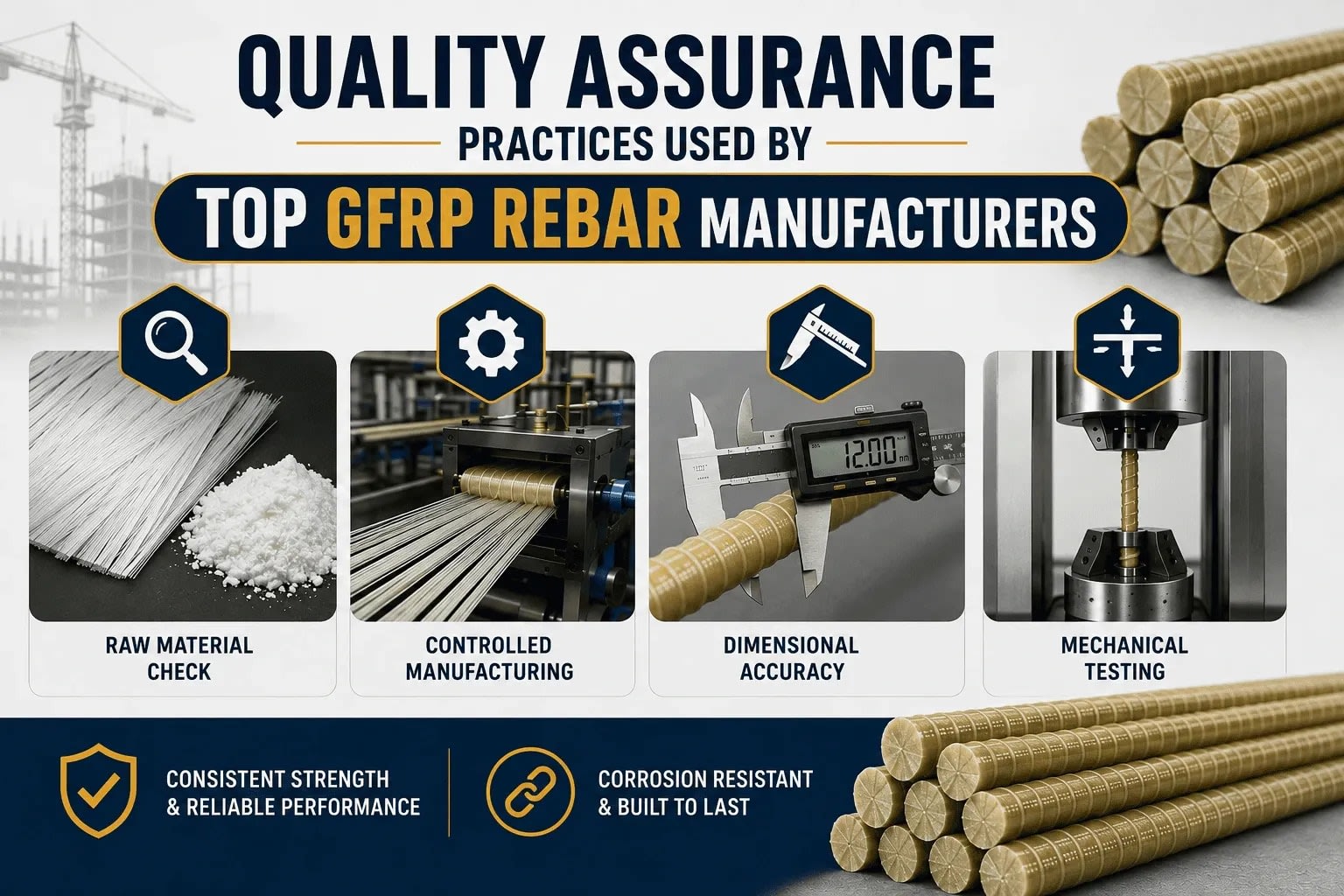
Top GFRP rebar manufacturers follow quality assurance practices at every stage of production. These include checking raw materials, controlling the manufacturing process, maintaining accurate dimensions, testing tensile performance, inspecting the finished bars, and maintaining batch-wise quality records. These steps help ensure that GFRP bars provide consistent strength, durability, and performance in construction projects.
Why Does Quality Matter When Choosing GFRP Rebar?
Quality is an important factor when choosing glass fiber reinforced polymer rebars because the reinforcement is expected to provide consistent performance inside concrete structures for many years. The quality of the glass fibers, resin system, manufacturing process, and final product can directly influence the strength, durability, and reliability of the reinforcement.
High-quality GFRP Rebar can provide important benefits such as:
- Consistent mechanical performance: Proper fiber alignment and resin bonding help maintain the required strength and performance.
- Corrosion resistance: GFRP is non-metallic and does not rust like conventional steel reinforcement, making it suitable for environments where corrosion is a concern.
- Dimensional consistency: Uniform diameter, length, and surface profile make the bars easier to handle, cut, and install.
- Long-term durability: Properly manufactured GFRP reinforcement can perform well in demanding environments exposed to moisture and other corrosive conditions.
- Reliable project performance: Consistent product quality gives engineers and contractors greater confidence when selecting reinforcement for different construction requirements.
This is why choosing GFRP Rebar should not be based on price alone. Contractors, engineers, and procurement teams should also consider the manufacturer's raw material quality, production controls, testing practices, product documentation, and ability to maintain consistency across batches.
For projects where durability, corrosion resistance, and reliable reinforcement performance are important, choosing quality GFRP Rebar can be a valuable long-term decision.
How Are Raw Materials Checked Before GFRP Rebar Production?
The quality of a fiberglass sariya starts with the materials used to manufacture it. Unlike conventional steel reinforcement, GFRP reinforcement is produced using glass fibers combined with a polymer resin system.
Manufacturers need to ensure that these materials meet the required specifications before production begins.
Key quality checks can include:
- Glass fiber quality and consistency.
- Resin and polymer system specifications.
- Proper fiber-resin compatibility.
- Material storage conditions.
- Batch identification and traceability.
- Verification of incoming material specifications.
Using consistent raw materials helps manufacturers maintain uniform mechanical properties throughout production.
For contractors and engineers, this is important because variations in raw materials can affect the performance and reliability of the finished reinforcement.
How Is the GFRP Rebar Manufacturing Process Controlled?
Quality assurance does not stop after raw materials are approved. The manufacturing process itself needs to be carefully controlled.
GFRP rebars are commonly produced through a continuous pultrusion-based process. During manufacturing, factors such as fiber alignment, resin impregnation, curing, surface formation, and dimensional consistency need to be monitored.
What Manufacturing Parameters Need to Be Controlled?
Some important parameters include:
- Fiber alignment and distribution.
- Resin impregnation.
- Curing conditions.
- Bar diameter and dimensional tolerance.
- Surface profile and bonding characteristics.
- Production speed and process consistency.
This is particularly important for high strength reinforcement bars, where consistent fiber distribution and resin bonding contribute to the required mechanical performance.
What Tests Are Performed on Finished GFRP Rebar?
Testing is one of the most important parts of quality assurance. After manufacturing, GFRP reinforcement can undergo different tests to evaluate its mechanical and physical characteristics.
Depending on the product specification and applicable standards, manufacturers may evaluate properties such as:
- Tensile strength.
- Bar diameter.
- Fiber content.
- Surface characteristics.
- Dimensional consistency.
- Resistance to environmental conditions.
Testing helps identify variations before products are supplied to construction projects.
For large infrastructure projects, maintaining documented test results and batch-level records can also help engineers and procurement teams verify product consistency.
How Is the Durability of GFRP Rebar Evaluated?
One of the major reasons engineers consider GFRP reinforcement is its resistance to corrosion compared with conventional steel reinforcement.
However, quality assurance should consider more than tensile strength. Manufacturers also need to evaluate how the material is expected to perform under demanding environmental conditions.
GFRP reinforcement can be particularly relevant for environments where conventional steel reinforcement may face corrosion concerns, including:
- Marine and coastal structures.
- Water treatment facilities.
- Bridges and infrastructure.
- Industrial structures.
- Parking structures.
- Concrete structures exposed to moisture and chemicals.
These characteristics make GFRP suitable for a wide range of gfrp applications, where long-term durability is an important project consideration.
How Can Contractors Choose a Reliable GFRP Rebar Manufacturer?
Contractors and procurement teams should evaluate more than product availability or pricing when selecting a supplier.
Consider these factors:
- Manufacturing capability – Can the manufacturer supply the required quantities consistently?
- Quality control – Are quality checks performed throughout production?
- Product testing – Are relevant mechanical and dimensional properties verified?
- Technical support – Can the supplier provide product information and installation guidance?
- Documentation – Are specifications and test records available?
- Project suitability – Does the product meet the requirements of the intended application?
For projects using fiberglass rebar in india, evaluating these factors can help engineers and contractors make a more informed procurement decision.
Why Is RebarX Focused on Quality Assurance?
RebarX focuses on providing GFRP reinforcement designed for modern construction requirements. Based in Madhya Pradesh, India, RebarX serves projects across India and supports the growing demand for durable, lightweight reinforcement solutions.
A structured approach to material selection, manufacturing, product inspection, and quality control helps ensure that GFRP reinforcement remains consistent from production to project delivery.
For contractors, engineers, and infrastructure procurement teams, this focus on quality can make GFRP reinforcement a practical option for projects where corrosion resistance, durability, and easier handling are important considerations.
Conclusion
Quality assurance is one of the most important factors when selecting GFRP reinforcement. From raw material inspection and controlled manufacturing to dimensional checks, mechanical testing, and product documentation, every stage contributes to the consistency and reliability of the final product.
For engineers, contractors, and procurement teams looking for top gfrp rebar manufacturers in india, the focus should not be limited to price. Manufacturing consistency, testing practices, technical support, documentation, and project suitability should also be considered.
With a focus on quality-driven GFRP reinforcement, RebarX aims to support modern construction projects across India and export markets with reliable reinforcement solutions.
FAQs
1. How do manufacturers ensure the quality of fiberglass sariya? Manufacturers ensure the quality of fiberglass sariya by checking raw materials, controlling the manufacturing process, monitoring dimensions, testing mechanical properties, and maintaining batch-wise quality records.
2. What tests are performed on glass fiber reinforced polymer reinforcement? Glass fiber reinforced polymer reinforcement can be tested for tensile strength, bar diameter, fiber content, dimensional consistency, surface characteristics, and resistance to relevant environmental conditions.
3. What should contractors check when choosing a glass fiber sariya manufacturer? Contractors should check the manufacturer's production capabilities, quality control practices, testing procedures, technical support, product documentation, and consistency across different batches of glass fiber sariya.