
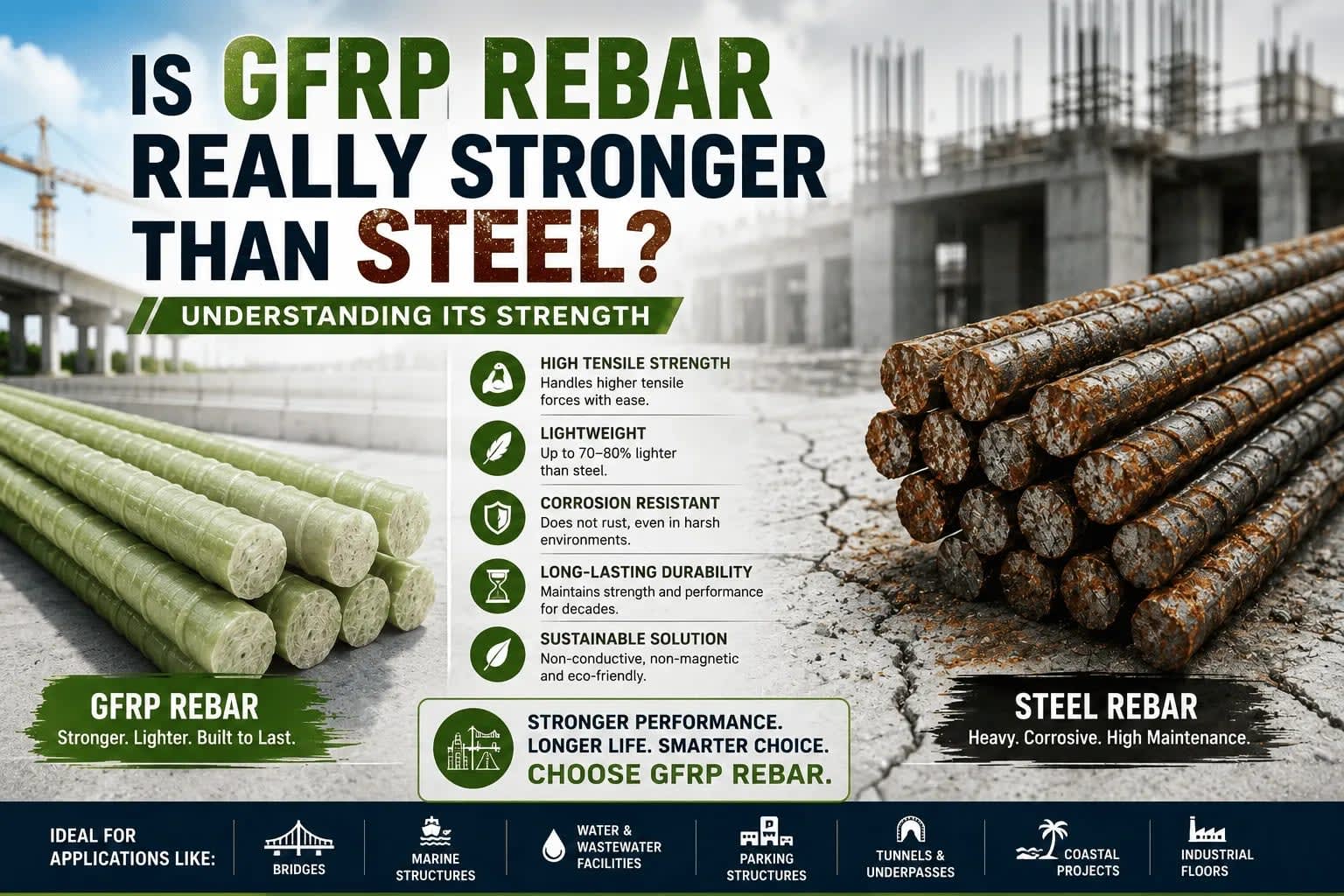
Is GFRP stronger than steel? For many modern construction applications, the answer is yes—particularly when considering tensile strength along with durability and long-term performance. GFRP rebar can provide higher tensile strength than conventional steel reinforcement while being significantly lighter and highly resistant to corrosion. Its continuous glass fibers deliver excellent tensile performance, making it a strong choice for concrete structures where strength, durability, and service life are important.
What makes GFRP rebar so strong?
GFRP, or Glass Fiber Reinforced Polymer, is a composite reinforcement material made by embedding high-strength glass fibers within a polymer resin. The continuous glass fibers run along the length of the bar, allowing it to effectively carry tensile loads.
This unique composition gives GFRP several strength-related advantages:
- High tensile strength: GFRP can withstand significant tensile forces.
- Excellent strength-to-weight ratio: It delivers high tensile capacity without the heavy weight of steel.
- Corrosion resistance: GFRP does not rust like conventional steel reinforcement.
- Long-term durability: Its resistance to corrosion makes it valuable in aggressive environments.
- Lightweight construction: GFRP bars are easier to transport, handle, and place on construction sites.
Therefore, when evaluating reinforcement based on tensile performance, weight, and durability together, GFRP offers a highly competitive solution.
Does GFRP have a better strength-to-weight ratio?
Yes. One of the biggest advantages of GFRP is its high strength-to-weight ratio. GFRP reinforcement is considerably lighter than steel while providing high tensile strength.
This lightweight characteristic can provide practical benefits during construction. Workers can handle longer lengths of reinforcement more easily, while transportation and movement around the job site can also become more convenient.
For large infrastructure projects, reducing reinforcement weight can be particularly beneficial for logistics and installation.
Why is corrosion resistance important for GFRP strength?
Strength is not only about how reinforcement performs when a structure is newly constructed. Long-term durability is equally important.
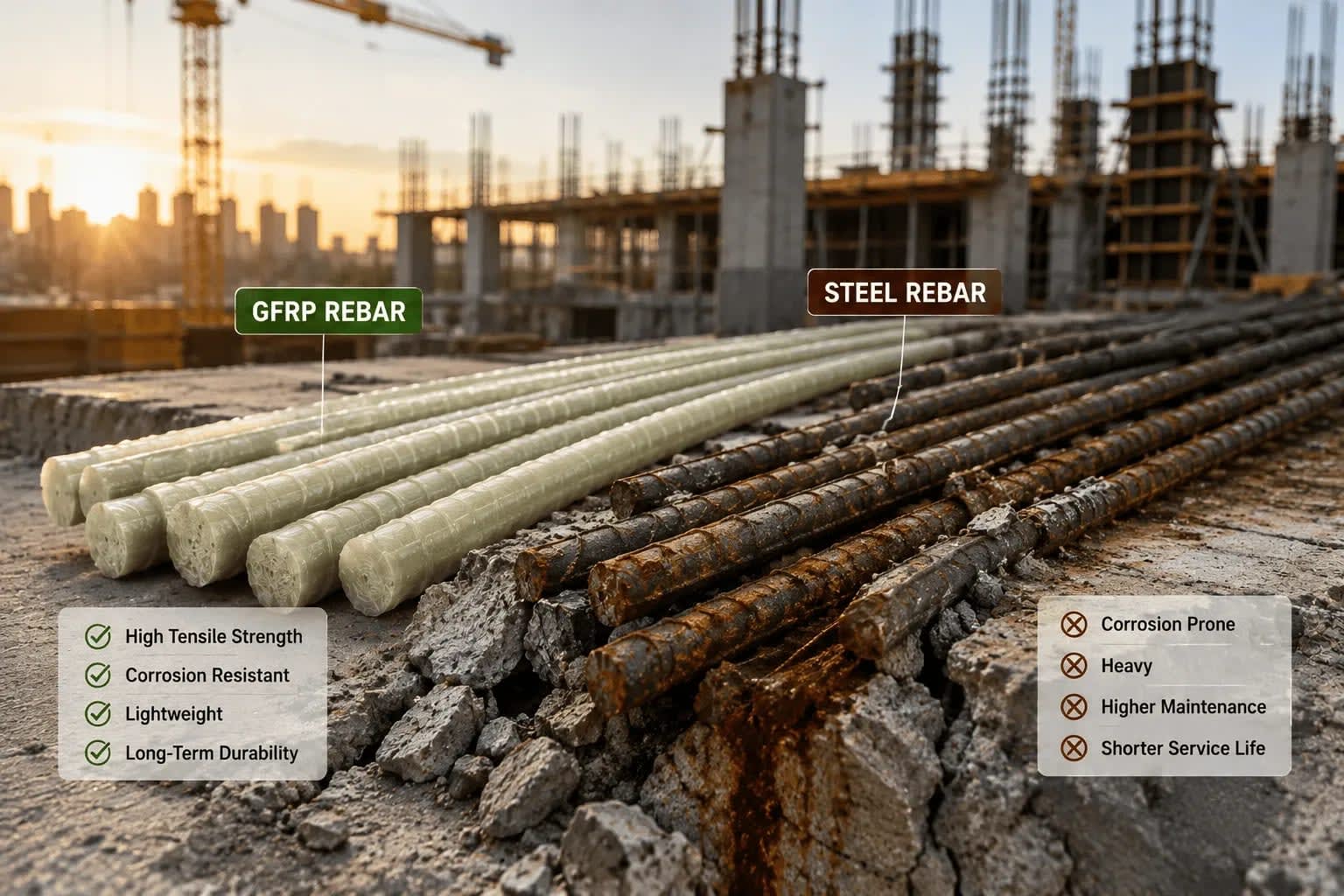
Steel reinforcement can be vulnerable to corrosion when concrete structures are exposed to moisture, chloride ions, saltwater, de-icing salts, or certain chemicals. Corrosion can cause steel to expand, potentially resulting in cracking and spalling of the surrounding concrete.
GFRP is inherently resistant to conventional corrosion. This allows it to maintain its reinforcement function in environments where corrosion could be a significant concern.
As a result, GFRP can be particularly valuable for structures that require durable reinforcement with long-term performance.
Where can GFRP rebar be used?
The gfrp rebar uses continue to expand as construction professionals recognize the benefits of corrosion-resistant reinforcement.
GFRP can be considered for applications such as:
- Bridges and bridge decks.
- Concrete roads and pavements.
- Parking structures.
- Water and wastewater facilities.
- Swimming pools.
- Marine and coastal structures.
- Tunnels.
- Industrial floors.
- Foundations.
- Retaining structures.
Its combination of tensile strength, lightweight construction, and corrosion resistance makes it especially useful in structures exposed to challenging environmental conditions.
What are the key strength advantages of GFRP Bars?
Instead of looking at strength as a single number, engineers can evaluate GFRP based on several performance characteristics.
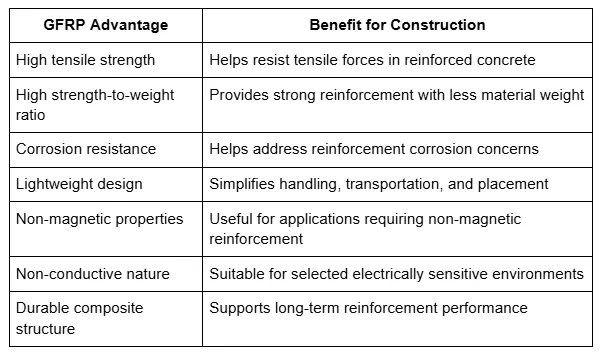
These combined characteristics make GFRP more than simply an alternative reinforcement bar. It provides a solution designed to address several challenges associated with modern concrete construction.
Why are GFRP Rebars gaining popularity in modern construction?
The increasing use of Gfrp Rebars is closely connected to the growing demand for durable and efficient infrastructure.
For structures exposed to moisture, salts, chemicals, or marine conditions, corrosion can become one of the biggest threats to reinforcement. GFRP addresses this challenge at the material level because it does not rust like steel.
Its low weight also provides practical advantages during transportation and installation. This combination of strength, durability, and lightweight handling makes GFRP increasingly attractive for modern construction projects.
How does GFRP support long-lasting infrastructure?
The growing adoption of gfrp in construction reflects a shift toward materials that can deliver reliable performance throughout a structure's service life.
A reinforcement material must do more than provide initial tensile capacity. It should also perform effectively under the environmental conditions to which the structure will be exposed.
GFRP can be particularly advantageous when projects require:
- High tensile reinforcement.
- Resistance to corrosion.
- Lightweight materials.
- Reduced handling challenges.
- Long-term durability.
- Non-magnetic reinforcement.
- Non-conductive reinforcement.
This makes it a strong candidate for infrastructure where durability and lifecycle performance are major priorities.
Why should contractors and engineers consider GFRP reinforcement?
The benefits of gfrp reinforcement extend beyond its high tensile strength. Its lightweight nature can make installation easier, while its corrosion resistance can help address one of the most common durability challenges associated with steel reinforcement.
For contractors, easier handling and transportation can improve site convenience. For infrastructure owners, corrosion resistance can be an important consideration when evaluating long-term performance.
However, GFRP should always be selected and designed according to the project's structural requirements and applicable standards. The appropriate bar size, spacing, design approach, and installation practices should be determined by qualified professionals.
Final Thoughts on GFRP Rebar Strength
GFRP rebar combines high tensile strength, an excellent strength-to-weight ratio, lightweight handling, and superior corrosion resistance, making it a reliable reinforcement option for modern construction and infrastructure projects. These benefits are especially valuable in structures exposed to moisture, salts, and other challenging environmental conditions.
For dependable reinforcement solutions, choosing from the top gfrp rebar manufacturers in india can help ensure consistent quality and products suited to specific project requirements. RebarX is committed to providing quality GFRP reinforcement solutions for construction and infrastructure projects across India.
FAQs
1. Is GFRP rebar stronger than steel?
Yes, GFRP rebar can offer higher tensile strength than conventional steel reinforcement. It also has a high strength-to-weight ratio and excellent corrosion resistance, making it a strong choice for applications where durability and long-term performance are important.
2. How long does fiberglass rebar last in concrete?
Fiberglass rebar can last 50 years or more in concrete when properly designed and installed. Its resistance to rust, corrosion, moisture, and salts makes it a durable choice for long-term construction projects.
3. What makes GFRP rebar a better alternative to steel?
GFRP rebar combines high tensile strength with lightweight construction and excellent resistance to corrosion. Unlike steel, it does not rust, which makes it particularly suitable for bridges, marine structures, roads, water infrastructure, and other environments where moisture and salts can affect reinforcement.
4. Where is GFRP rebar commonly used?
GFRP rebar is commonly used in bridges, concrete roads, parking structures, swimming pools, tunnels, water and wastewater facilities, marine structures, foundations, and other concrete applications. It is especially beneficial in projects where corrosion resistance, lightweight handling, and long-term durability are priorities.