
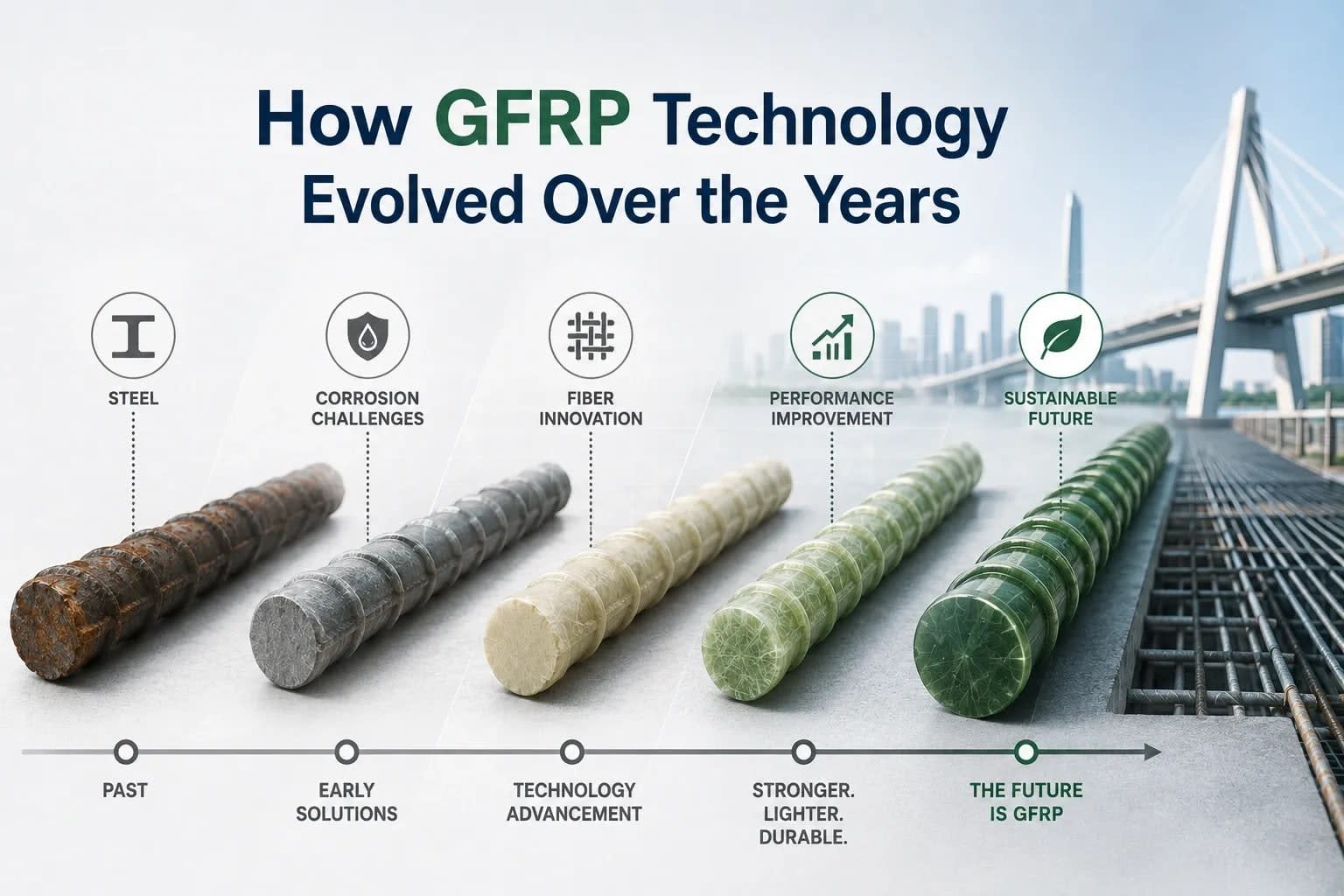
Introduction
Glass Fiber Reinforced Polymer, commonly known as GFRP, has become one of the most advanced materials used in modern construction and engineering. Over the years, this technology has evolved from a simple fiberglass-based material into a highly durable and reliable solution for infrastructure, industrial applications, transportation, and marine projects. Today, GFRP is widely recognized for its corrosion resistance, lightweight structure, and long service life, making it a preferred alternative to traditional steel reinforcement in many environments.
The evolution of GFRP technology reflects the changing demands of the construction industry. Engineers and developers continuously search for materials that offer better durability, lower maintenance costs, and improved structural performance. GFRP successfully addresses these requirements, which is why its adoption has grown rapidly across the globe.
The Early Beginning of GFRP Technology
The story of GFRP began in the early twentieth century when fiberglass was first developed. Scientists discovered that thin strands of glass could be combined with resin materials to create a strong yet lightweight composite. Initially, fiberglass was mainly used for insulation and simple industrial products because of its resistance to moisture and chemicals.
During the 1930s and 1940s, industries such as aerospace and marine manufacturing started exploring fiberglass for structural applications. Engineers realized that combining glass fibers with polymer resin created a material that was not only lightweight but also exceptionally durable. This marked the foundation of what would later become modern GFRP technology.
The Expansion of Composite Materials After World War II
The years following World War II saw rapid industrial growth and technological advancement. Industries required materials that could deliver higher strength while reducing overall weight. Traditional materials such as steel and aluminum were effective, but they also had limitations related to corrosion, maintenance, and weight.
During this period, GFRP composites became increasingly popular in aircraft manufacturing, boats, industrial tanks, and chemical plants. Manufacturers improved resin formulations and production techniques, which significantly enhanced the strength and reliability of GFRP products. The material gained attention because it could withstand harsh environments without deteriorating quickly.
This period played an important role in establishing GFRP as a serious engineering material rather than just an experimental product.
Introduction of GFRP in the Construction Industry
As urbanization and infrastructure development increased, the construction industry faced a major challenge related to steel corrosion. Concrete structures reinforced with steel often suffer from rust, especially in coastal areas, industrial zones, and water treatment facilities. Corrosion weakened structures over time and increased maintenance costs significantly.
Engineers began searching for alternatives that could provide long-term durability without the problems associated with steel reinforcement. This search led to the introduction of GFRP in construction applications during the 1960s and 1970s.
GFRP demonstrated excellent resistance to moisture, salt, and chemicals. Unlike steel, it did not rust when exposed to harsh environmental conditions. This made it highly suitable for bridges, marine structures, tunnels, and high-moisture infrastructure projects.
The successful use of GFRP in these applications marked a turning point in the evolution of composite reinforcement technology.
Advancements in Manufacturing Technology
The 1980s brought major improvements in the manufacturing processes used for GFRP products. Earlier production methods often lacked consistency, which limited large-scale adoption. However, advanced techniques such as pultrusion and filament winding transformed the industry.
Pultrusion technology allowed manufacturers to produce continuous GFRP profiles with uniform strength and better dimensional accuracy. This process improved product quality while reducing manufacturing costs. As a result, GFRP products became more accessible for commercial and infrastructure projects.
The development of precision manufacturing also increased confidence among engineers and contractors. Structures reinforced with GFRP started showing excellent long-term performance in demanding environments.
The Development of GFRP Rebars
One of the most significant milestones in the evolution of GFRP technology was the development of GFRP rebars. Traditional steel rebars had long been the standard reinforcement material for concrete structures, but corrosion remained a major issue.
GFRP rebars offered a revolutionary alternative because they were completely resistant to rust and chemical corrosion. Their lightweight nature also made transportation and installation easier compared to steel reinforcement.
As infrastructure projects became more complex, the demand for durable reinforcement materials increased. GFRP rebars quickly gained popularity in bridges, highways, parking structures, coastal buildings, and water treatment plants where long-term durability was essential.
Over time, engineers realized that although GFRP might sometimes involve a different initial investment, its reduced maintenance requirements and longer service life made it a better long-term investment than steel in many applications.
Research and Standardization in the 1990s
The 1990s were crucial for the acceptance of GFRP technology in mainstream construction and engineering. During this decade, universities, research institutions, and government organizations conducted extensive studies to evaluate the structural performance of GFRP materials.
Research confirmed that GFRP offered high tensile strength, excellent fatigue resistance, and superior durability under challenging environmental conditions. These findings encouraged engineering authorities to develop design codes and standards specifically for GFRP applications.
The establishment of technical standards helped improve industry confidence and allowed engineers to design structures using GFRP with greater accuracy and reliability. This period significantly accelerated the commercial adoption of composite reinforcement systems.
Modern GFRP Technology in the Twenty-First Century
In the modern era, GFRP technology has advanced far beyond its early forms. Manufacturers now use highly sophisticated resin systems that improve structural performance, fire resistance, UV stability, and chemical durability.
Modern production facilities rely on automated machinery and computer-controlled systems to ensure consistent quality. These advancements have made GFRP products stronger, more reliable, and more cost-effective than ever before.
Today, GFRP is widely used in infrastructure projects around the world because it provides long-lasting performance with minimal maintenance requirements. Engineers increasingly prefer GFRP for projects exposed to moisture, chemicals, and extreme weather conditions.
Growing Importance of Sustainable Construction
Sustainability has become one of the most important factors in modern construction practices. Governments and developers now focus on materials that can reduce environmental impact while improving infrastructure lifespan.
GFRP supports sustainable construction because of its durability and corrosion resistance. Structures reinforced with GFRP require fewer repairs and replacements over time, which reduces material consumption and maintenance activities. Its lightweight nature also lowers transportation energy requirements.
As global infrastructure demands continue to grow, the need for durable and sustainable materials has positioned GFRP as a key solution for future construction projects.
How GFRP Changed Modern Infrastructure
The evolution of GFRP technology has significantly influenced modern infrastructure development. Bridges, highways, tunnels, marine structures, and industrial facilities increasingly use GFRP components because of their long-term performance advantages.
In coastal environments where steel corrosion is a major concern, GFRP has proven highly effective in extending the lifespan of structures. Infrastructure owners benefit from lower maintenance costs and improved structural reliability.
The adoption of GFRP has also improved construction efficiency because its lightweight properties simplify transportation and installation. These advantages make GFRP especially valuable for large-scale infrastructure projects.
Current Innovations in GFRP Technology
Modern research continues to push the boundaries of GFRP technology. Engineers are developing hybrid composite systems that combine GFRP with other advanced materials to improve strength and flexibility.
Digital engineering tools such as Building Information Modeling and advanced structural analysis software are also helping optimize GFRP applications. These technologies allow engineers to design safer and more efficient structures using composite materials.
Innovations in recycling and environmentally friendly resin systems are expected to further improve the sustainability of GFRP products in the coming years.
The Future of GFRP Technology
The future of GFRP technology appears extremely promising as industries continue to prioritize durability, sustainability, and long-term cost efficiency. The demand for corrosion-resistant materials is expected to rise significantly with the expansion of smart cities, transportation networks, and modern infrastructure projects.
Future advancements may lead to stronger and lighter GFRP formulations, improved recyclable composites, and wider adoption in earthquake-resistant structures. As awareness about lifecycle cost savings increases, more industries are expected to shift from traditional steel reinforcement toward advanced composite materials.
GFRP is no longer considered a niche technology. It has become an essential part of modern engineering and is expected to play an even greater role in the future of global infrastructure.
Conclusion
The evolution of GFRP technology represents decades of innovation in material science and engineering. From its origins in fiberglass manufacturing to its widespread use in modern infrastructure, GFRP has continuously evolved to meet the changing needs of the construction industry.
Its corrosion resistance, lightweight structure, durability, and low maintenance requirements have made it one of the most valuable alternatives to traditional steel reinforcement. As modern infrastructure projects demand longer service life and better sustainability, GFRP technology continues to gain momentum worldwide.
With ongoing advancements in manufacturing, design, and material performance, GFRP is expected to remain a leading solution for future construction and engineering applications.
FAQs
What is GFRP technology?
GFRP technology refers to the use of Glass Fiber Reinforced Polymer composites in construction, infrastructure, and industrial applications.
Why is GFRP becoming popular in construction?
GFRP is becoming popular because it offers corrosion resistance, lightweight handling, durability, and lower long-term maintenance costs.
How is GFRP different from steel reinforcement?
Unlike steel, GFRP does not rust or corrode, making it more suitable for harsh environmental conditions and long-term infrastructure projects.
Where is GFRP commonly used today?
GFRP is commonly used in bridges, tunnels, highways, marine structures, industrial facilities, and water treatment plants.
What is the future scope of GFRP technology?
The future of GFRP technology includes wider use in sustainable construction, smart infrastructure, and advanced composite engineering solutions.