
When people talk about high-strength reinforcement bars, steel usually steals the spotlight. But in modern construction, a powerful alternative is rapidly gaining ground—GFRP bars. For builders seeking durability, corrosion resistance, and long-term performance, Glass Fiber Reinforced Polymer (GFRP) bars are no longer a futuristic concept; they are a present-day solution.
If your projects demand strength without corrosion, lightweight handling, and extended service life, understanding GFRP bars is essential.
What Are GFRP Reinforcement Bars?
GFRP bars are high-strength, non-metallic reinforcement bars made from glass fibers embedded in a polymer resin matrix. Unlike traditional steel rebars, GFRP bars do not rust, corrode, or react with chemicals in concrete or the environment.
From a performance standpoint, GFRP bars offer exceptionally high tensile strength—often higher than steel—while weighing only a fraction of it. This unique combination makes them ideal for structures exposed to moisture, chemicals, or aggressive environmental conditions.
In simple terms, GFRP bars act like a high-performance composite backbone inside concrete, delivering strength without the weaknesses associated with steel.
Why GFRP Bars Are Considered High-Strength Reinforcement
High strength is not just about how much load a bar can carry—it’s about how reliably it performs over time. GFRP bars excel here for several reasons:
- High tensile strength: GFRP bars typically exceed the tensile strength of conventional steel rebars.
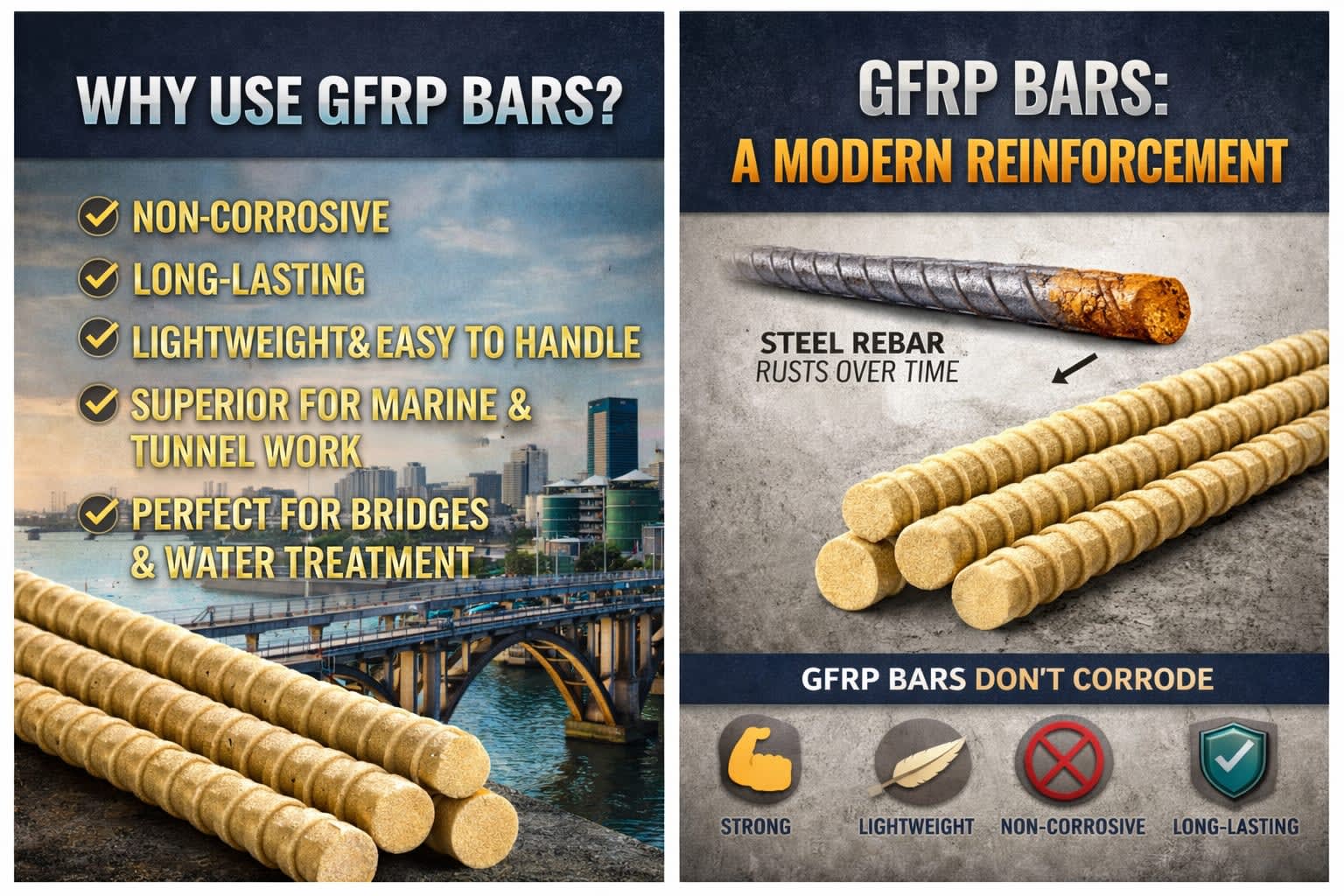
- No corrosion: Since they are non-metallic, they are immune to rust, even in marine or chemically aggressive environments.
- Consistent performance: No loss of cross-section due to corrosion means long-term structural reliability.
While GFRP bars behave differently from steel in terms of elasticity, modern design codes account for this, allowing engineers to safely and effectively use them in a wide range of applications.
Key Advantages of GFRP Bars for Builders
For builders and contractors, GFRP reinforcement bars offer practical, on-site advantages that go beyond structural performance:
- Lightweight handling: GFRP bars are up to 75% lighter than steel, reducing labor fatigue and speeding up installation.
- Easy transportation: Lower weight means reduced shipping and handling costs.
- Electromagnetic neutrality: GFRP bars do not conduct electricity or interfere with electronic signals, making them ideal for use in hospitals, laboratories, and data centers.
- Long service life: Structures reinforced with GFRP bars require minimal maintenance over time.
These benefits make GFRP bars especially attractive for projects where long-term durability matters more than short-term material cost.
Where GFRP Bars Are Commonly Used
GFRP reinforcement bars are widely used in projects where steel reinforcement struggles to perform:
- Industrial sheds
- Poultry farms
- Bridges and highways exposed to de-icing salts
- Water treatment plants and tanks
- Basements, foundations, and parking structures
- Industrial floors and chemical plants
In these environments, corrosion is not a possibility—it’s a certainty. GFRP bars eliminate that risk.
Design Considerations When Using GFRP Bars
Builders should understand that GFRP bars behave differently from steel and must be designed accordingly. They have a linear elastic behavior and do not yield like steel, which means the design focuses more on serviceability limits such as deflection and crack control.
Proper spacing, concrete cover, and adherence to design standards (such as ACI and CSA guidelines) are critical. When used correctly, GFRP bars deliver outstanding performance without compromising safety.
Why Builders Are Switching from Steel to GFRP Bars
The shift toward GFRP reinforcement bars is driven by long-term thinking. While steel may appear cheaper initially, corrosion-related repairs can significantly increase lifecycle costs. GFRP bars eliminate these hidden expenses.
For builders, this means:
- Fewer callbacks and repairs
- Higher client satisfaction
- Structures designed to last 100+ years
In many infrastructure and commercial projects, GFRP bars are now the smarter, future-proof choice.
Conclusion
High-strength reinforcement bars are evolving, and GFRP bars represent the next generation of construction reinforcement. With high tensile strength, zero corrosion, lightweight handling, and long-term durability, GFRP bars offer builders a powerful alternative to traditional steel.
For projects exposed to harsh environments or demanding longevity, are not just an option—they are the best solution.
FAQs
1. Are GFRP bars stronger than steel rebars? Yes, in terms of tensile strength, GFRP bars often exceed those of steel, although they behave differently under load.
2. Do GFRP bars rust or corrode? No. GFRP bars are completely corrosion-resistant.
3. Can GFRP bars be used in residential construction? Yes, especially in foundations, basements, and slabs exposed to moisture.
4. Are GFRP bars approved by building codes? Yes, many international standards and guidelines support the use of GFRP reinforcement.
5. Are GFRP bars cost-effective? While the initial cost may be higher, the long-term savings from zero corrosion and low maintenance make them highly cost-effective.