
Modern construction demands materials that deliver strength, durability, and long-term value. Traditional steel reinforcement, while widely used, faces serious limitations—especially corrosion, maintenance costs, and reduced service life in aggressive environments.
This is where Glass Fibre Reinforcement Bars (GFRP bars) emerge as a next-generation solution. Designed for performance-driven infrastructure and industrial projects, GFRP bars offer a corrosion-free, lightweight, and high-strength alternative to steel reinforcement.
This guide explains Glass Fibre Reinforcement Bars in simple terms, while helping engineers, contractors, and project owners understand why GFRP bars are becoming the preferred choice in modern construction.
What Are Glass Fibre Reinforcement Bars? (Featured Snippet Optimized)
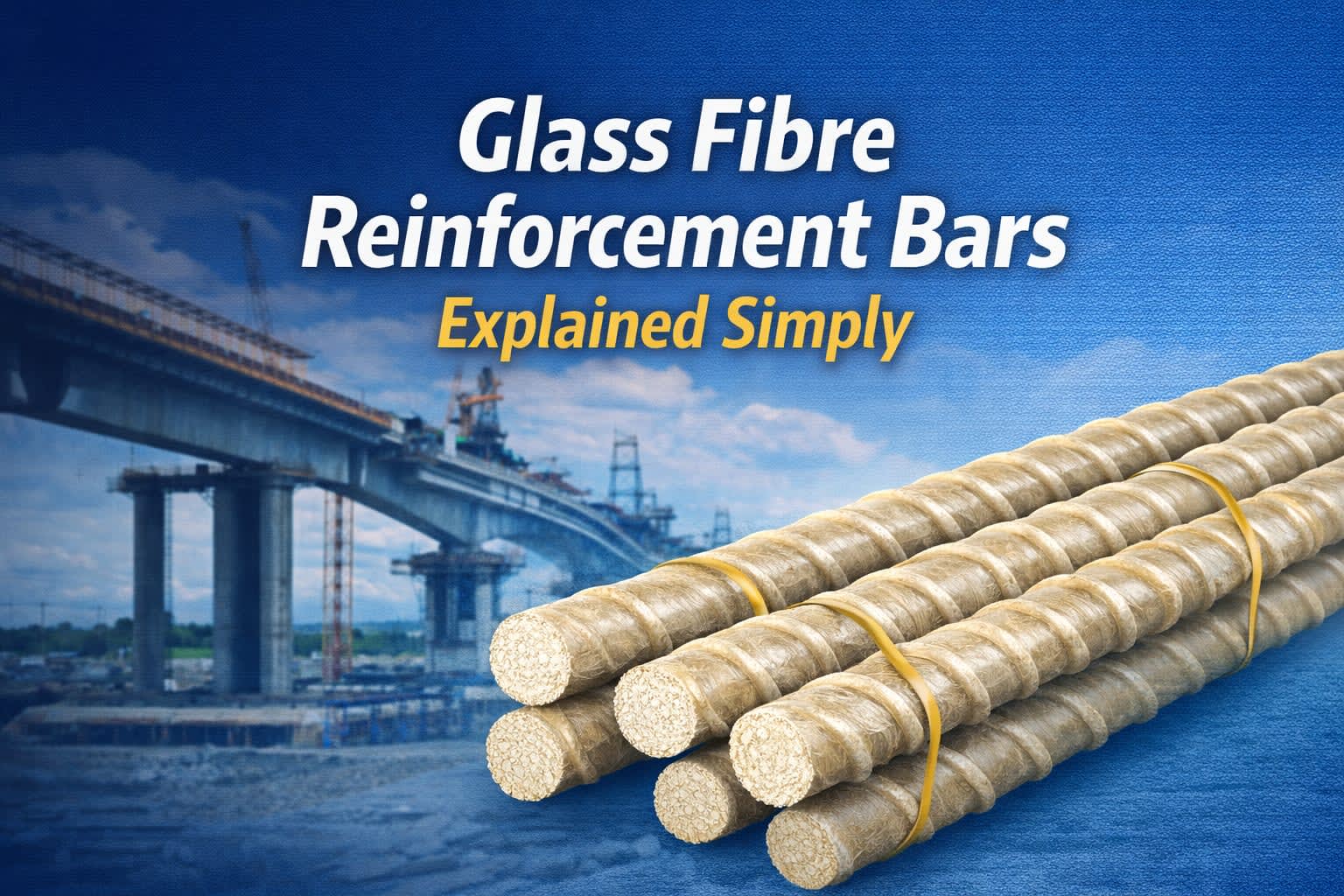
Glass Fibre Reinforcement Bars (GFRP bars) are composite reinforcement bars made from high-strength glass fibers embedded in a polymer resin matrix. They are used in concrete structures as a non-corrosive alternative to steel reinforcement.
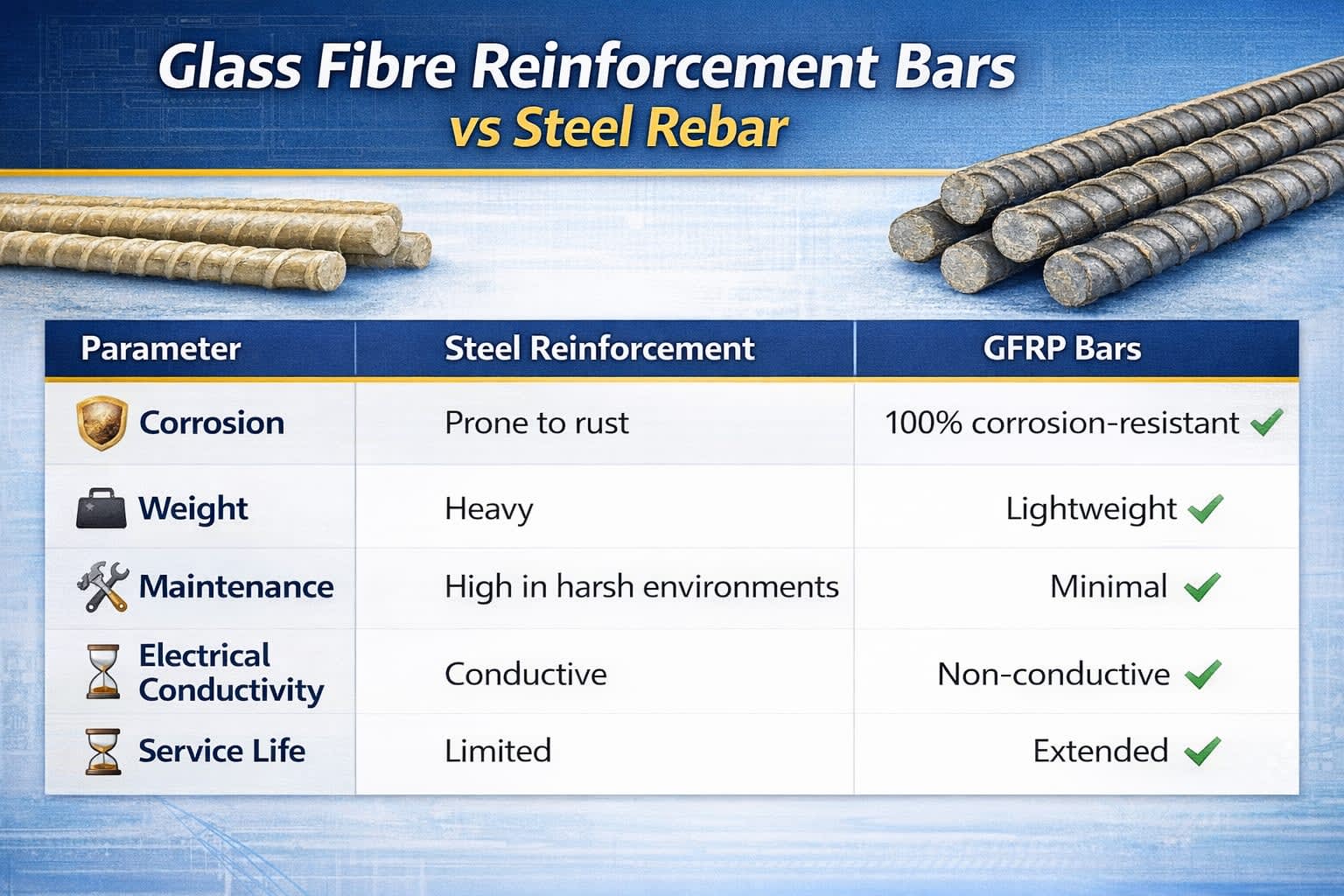
Unlike steel, GFRP bars do not rust, conduct electricity, or react with chemicals—making them ideal for demanding construction environments.
How GFRP Bars Are Manufactured
GFRP bars are produced using a controlled process known as pultrusion, ensuring consistent quality and mechanical properties.
Manufacturing process overview:
- High-strength glass fibers are aligned longitudinally
- Fibers are saturated with premium polymer resin
- The composite is cured and shaped into bars
- A surface treatment or sand coating is applied for superior concrete bonding
This process results in reinforcement bars with excellent tensile strength, dimensional accuracy, and durability.
Why the Construction Industry Is Shifting to GFRP Bars
Steel reinforcement has one major drawback—corrosion. When steel corrodes, it expands, cracks concrete, and significantly reduces structural life.
GFRP bars eliminate this issue.
Key reasons for adopting Glass Fibre Reinforcement Bars:
- Zero corrosion, even in harsh environments
- Reduced lifecycle and maintenance costs
- Longer structural lifespan
- Improved structural reliability
For infrastructure projects designed for 50–100+ years of service life, GFRP bars provide a clear advantage.
Key Technical Advantages of Glass Fibre Reinforcement Bars
1. Complete Corrosion Resistance
GFRP bars are immune to rust, moisture, salts, chlorides, and chemicals—making them ideal for marine, coastal, and industrial structures.
2. High Tensile Strength
Glass fibres provide exceptional tensile strength, often higher than steel on a strength-to-weight basis.
3. Lightweight and Easy Handling
GFRP bars are up to 75% lighter than steel, reducing:
- Transportation costs
- Installation time
- On-site labor fatigue
4. Non-Conductive & Non-Magnetic
Ideal for applications requiring electromagnetic neutrality, such as:
- Hospitals
- Power substations
- Research facilities
5. Long-Term Durability
With no corrosion and minimal degradation, GFRP-reinforced structures require significantly less maintenance over time.
Applications of Glass Fibre Reinforcement Bars
GFRP bars are widely used in projects where durability and lifecycle performance matter most.
Industries & Farms
- Poultry farms
- Industrial buildings
Marine & Coastal Structures
- Jetties and ports
- Seawalls and docks
- Offshore platforms
Industrial & Utility Projects
- Wastewater treatment plants
- Chemical processing facilities
- Cooling towers and foundations
Commercial & Residential Construction
- Foundations and slabs
- Parking structures
- Basements and podiums
Glass Fibre Reinforcement Bars vs Steel Rebar
Design & Engineering Considerations
GFRP bars behave differently from steel and must be designed accordingly.
Important considerations:
- Linear elastic behavior (no yielding like steel)
- Lower modulus of elasticity than steel
- Proper anchorage length required
- Compliance with international design codes
When designed correctly, GFRP bars deliver safe, reliable, and predictable performance.
Sustainability & Environmental Benefits
Glass Fibre Reinforcement Bars support sustainable construction by:
- Reducing repair and replacement frequency
- Lowering material wastage
- Extending structural life cycles
- Minimizing corrosion-related environmental damage
This makes GFRP bars an excellent choice for green and future-ready infrastructure projects.
Why Choose a Certified GFRP Bar Manufacturer
A reliable manufacturer ensures:
- Compliance with international standards
- Consistent mechanical properties
- Quality-controlled production
- Technical support for design and execution
Choosing the right supplier directly impacts project safety, durability, and ROI.
Future of Glass Fibre Reinforcement Bars
With increasing focus on long-life infrastructure and low-maintenance construction, GFRP bars are rapidly gaining acceptance worldwide.
As design codes expand and awareness grows, Glass Fibre Reinforcement Bars are expected to become a standard reinforcement solution across infrastructure, industrial, and commercial construction.
Conclusion
Glass Fibre Reinforcement Bars represent a smart shift from traditional steel reinforcement toward durable, corrosion-free, and high-performance construction.
By offering superior strength, lightweight handling, extended service life, and reduced maintenance costs, GFRP bars are not just an alternative—but a strategic investment in long-term structural performance.
For builders, engineers, and project owners focused on reliability and lifecycle value, Glass Fibre Reinforcement Bars are the future of reinforced concrete construction.