
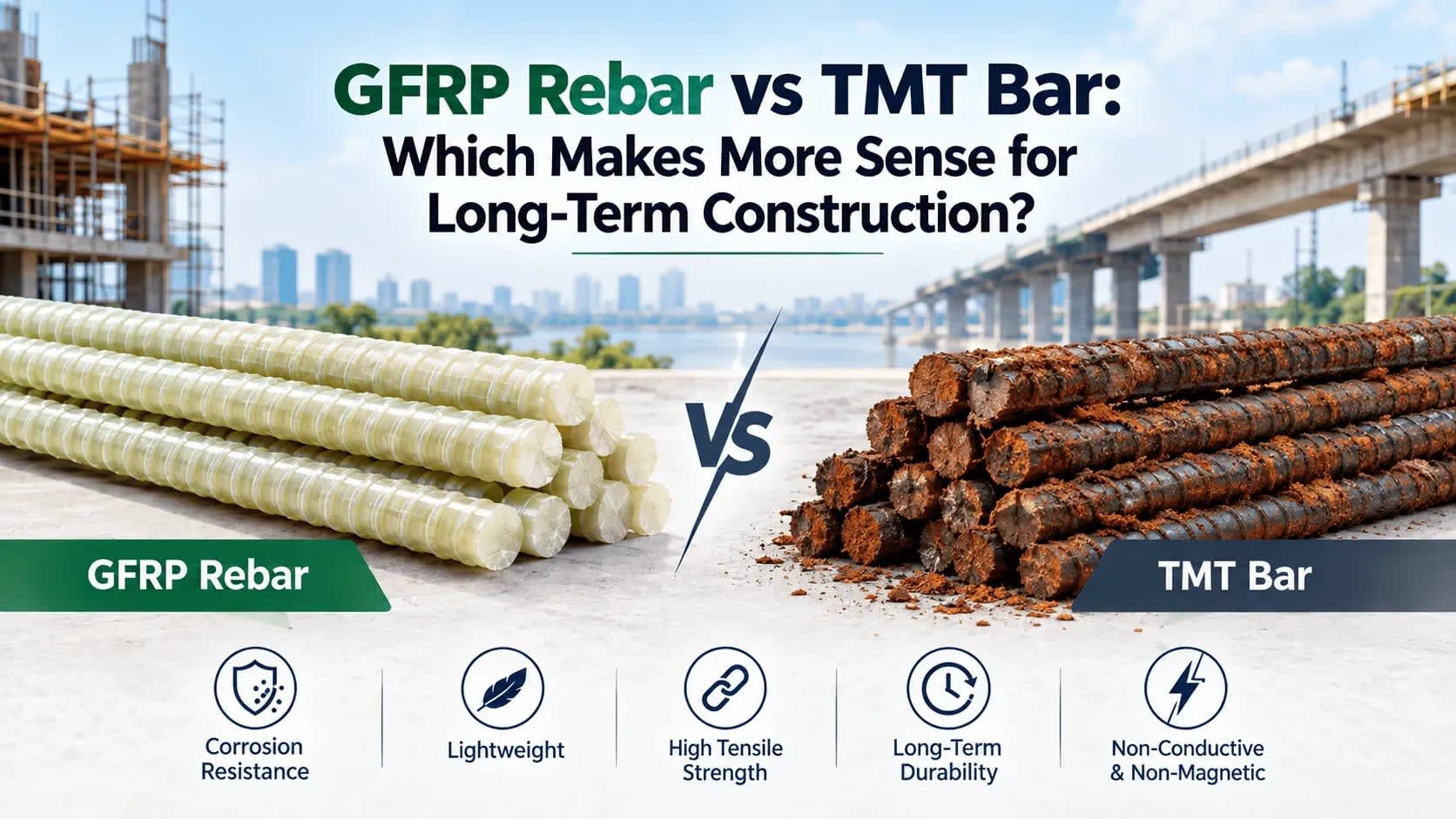
When choosing reinforcement for a construction project, strength is only one part of the decision. GFRP bars vs TMT bar is an increasingly important comparison as engineers and contractors look for reinforcement that can deliver durability, lower maintenance, and reliable long-term performance.
Which Makes More Sense for Long-Term Construction: GFRP Rebar or TMT Bar?
For long-term construction, GFRP rebar offers major advantages through its corrosion resistance, lightweight design, high tensile strength, and long-lasting performance. Unlike TMT bars, which are heavier and can develop rust and corrosion in moisture- or chemical-exposed environments, GFRP does not rust, making it a strong choice for demanding construction applications.
Why Are Engineers Choosing GFRP Rebar Over TMT Bars?
GFRP rebar is gaining attention as a high-performance reinforcement solution because it combines high tensile strength, excellent corrosion resistance, lightweight handling, and long-term durability. Made from glass fibers embedded in a polymer resin, GFRP is designed to perform reliably in demanding construction environments.
TMT bars are used, but their steel composition makes them vulnerable to rust and corrosion when exposed to moisture, salts, chemicals, and other aggressive conditions. They are also significantly heavier, which can make transportation, handling, and installation more demanding.
GFRP offers a different approach. It does not rust, has an excellent strength-to-weight ratio, and is much lighter than steel reinforcement. These properties make it particularly valuable for water-exposed, marine, infrastructure, and other projects where long-term durability is a priority.
What Makes GFRP a Smart Reinforcement Choice?
- Excellent corrosion resistance – Does not rust or corrode like steel.
- High tensile strength – Suitable for demanding reinforcement requirements.
- Lightweight – Easier to transport, carry, and install.
- Non-conductive and non-magnetic – Useful for specialized construction environments.
- Long-term durability – Performs reliably in many challenging conditions.
With this combination of strength, durability, and easy handling, GFRP offers a modern reinforcement solution for projects where long-term performance is a priority.
Is GFRP Stronger Than Steel?
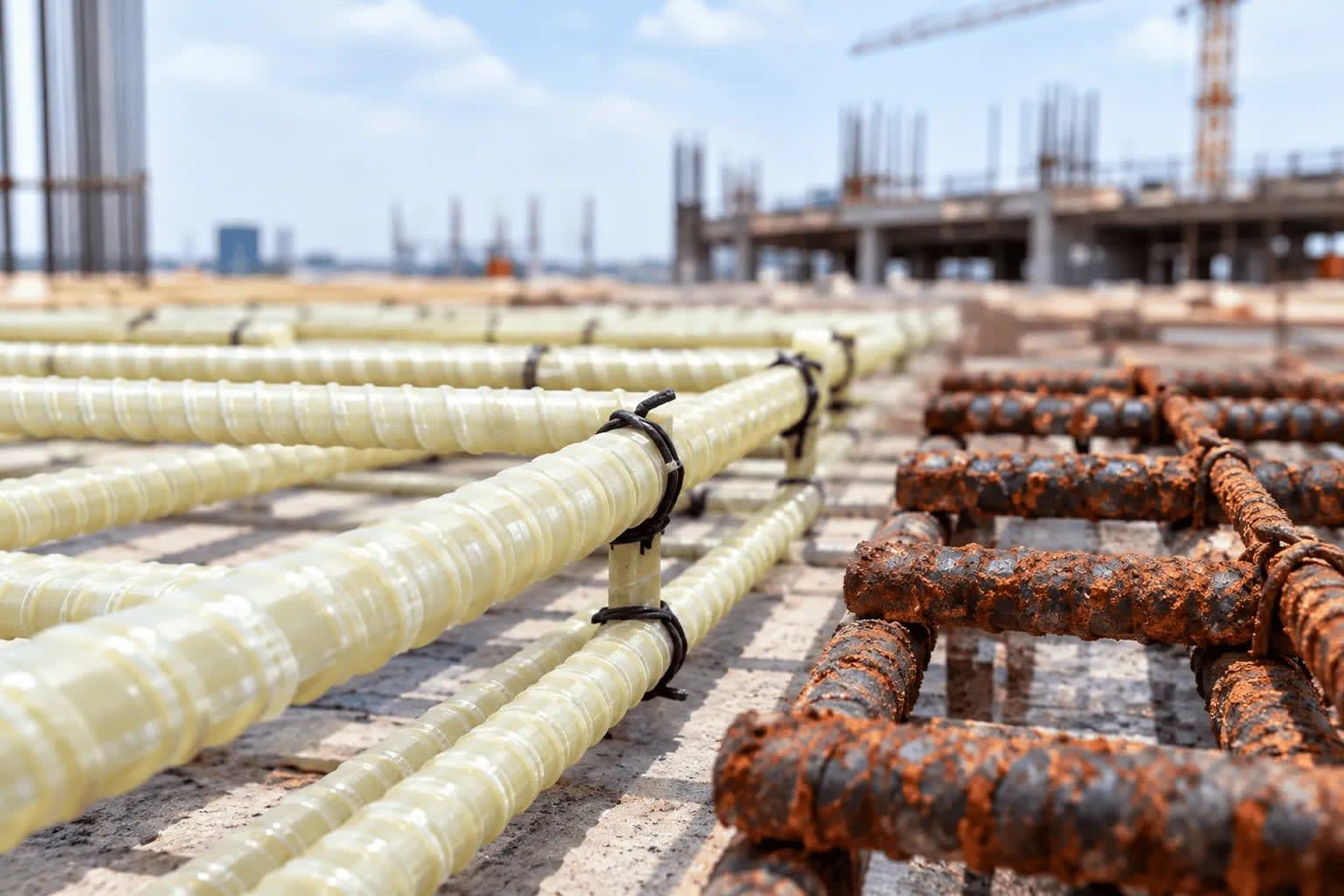
A common question is - is gfrp stronger than steel? Yes, GFRP rebar offers very high tensile strength along with an excellent strength-to-weight ratio, making it a powerful reinforcement option without the heavy weight associated with steel reinforcement.
Steel reinforcement is heavier and can be vulnerable to rust and corrosion when exposed to moisture, salts, and aggressive environments. GFRP, on the other hand, does not rust and provides high tensile performance while remaining lightweight, making it especially valuable for long-term and demanding construction applications.
For projects requiring high strength reinforcement bars, corrosion resistance, and easier handling, GFRP offers a compelling alternative to conventional steel reinforcement.
Why Is Corrosion Resistance a Major Advantage of GFRP?
Corrosion is one of the biggest long-term concerns with steel reinforcement. When moisture, salts, chlorides, or chemicals reach steel, corrosion can begin and eventually affect the surrounding structure.
GFRP offers a significant advantage because it does not rust.
This makes it particularly suitable for construction exposed to:
- Water and moisture
- Marine environments
- Chlorides and salts
- Wastewater
- Chemicals
- High-humidity conditions
By eliminating conventional steel corrosion, GFRP can help address one of the key durability challenges associated with reinforcement.
How Does GFRP Sariya Make Construction Easier?
Another important advantage of gfrp sariya is its lightweight nature.
Compared with steel reinforcement, GFRP is much easier to transport, carry, position, and handle at a construction site. This can be especially useful on projects involving large quantities of reinforcement or difficult site access.
GFRP can also be cut using suitable tools, allowing contractors to manage reinforcement efficiently according to project requirements.
For construction teams, its lightweight design can provide practical benefits without compromising its role as a high-performance reinforcement material.
What Are the Main GFRP Rebar Uses?
The range of gfrp rebar uses continues to expand as engineers become more familiar with non-metallic reinforcement.
GFRP is particularly useful where corrosion resistance and durability are important. Common applications include:
- Bridges and highways
- Water and wastewater structures
- Marine and coastal projects
- Parking structures
- Pools
- Industrial facilities
- Roads and transportation infrastructure
- Residential and commercial construction
- Electrically sensitive environments
These applications show why gfrp in construction is becoming increasingly relevant for projects where conventional steel reinforcement may face corrosion or handling challenges.
GFRP Rebar vs TMT Bar: Which Offers More Long-Term Value?
The biggest difference between GFRP and TMT is not simply strength. It is how the materials respond to their surrounding environment.
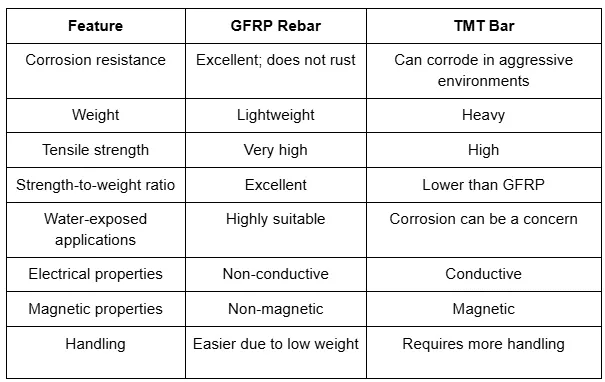
For projects where long-term durability and corrosion resistance are priorities, GFRP offers a strong value proposition.
Why Is GFRP Becoming a Smart Choice for Modern Construction?
The growing interest in GFRP comes from its ability to combine several useful properties in one reinforcement material. It is lightweight, corrosion-resistant, non-metallic, and offers high tensile strength.
For engineers, contractors, infrastructure procurement teams, and homeowners, this means GFRP can be considered for projects where long-term performance is more important than simply following conventional reinforcement practices.
Why Choose RebarX for GFRP Rebar?
RebarX manufactures GFRP reinforcement designed for modern construction requirements and serves customers across India and export markets.
As demand for corrosion-resistant reinforcement grows, choosing a dependable manufacturer is essential for consistent product quality and project performance. RebarX supports the adoption of GFRP reinforcement across suitable infrastructure and construction applications.
Conclusion
The gfrp bars vs tmt bar comparison shows why GFRP is becoming an attractive reinforcement solution for long-term construction. Its high tensile strength, lightweight nature, corrosion resistance, and non-metallic properties give it important advantages in demanding environments.
For projects exposed to water, salts, chemicals, or moisture, GFRP can help eliminate conventional rust-related reinforcement concerns. Its easy handling and wide range of applications further strengthen its value for modern construction.
As adoption continues to grow, working with experienced gfrp rebar manufacturers in india can help engineers and contractors bring the benefits of GFRP into suitable construction and infrastructure projects.
FAQs
1. What is the difference between GFRP rebar and TMT bars?GFRP rebar is made from glass fibers and polymer resin, while TMT bars are made from steel. GFRP is lightweight and corrosion-resistant, whereas TMT bars can be affected by corrosion in aggressive environments.
2. Why choose GFRP rebar instead of TMT bars?GFRP offers excellent corrosion resistance, lightweight handling, high tensile strength, and long-term durability. These advantages make it particularly useful for water-exposed and chemically aggressive construction environments.
3. Which lasts longer, GFRP rebar or TMT bars?GFRP rebar can last 50+ years without rust-related deterioration, while TMT bars can face corrosion over time when exposed to moisture. This makes GFRP a strong long-term reinforcement choice for demanding construction conditions.