
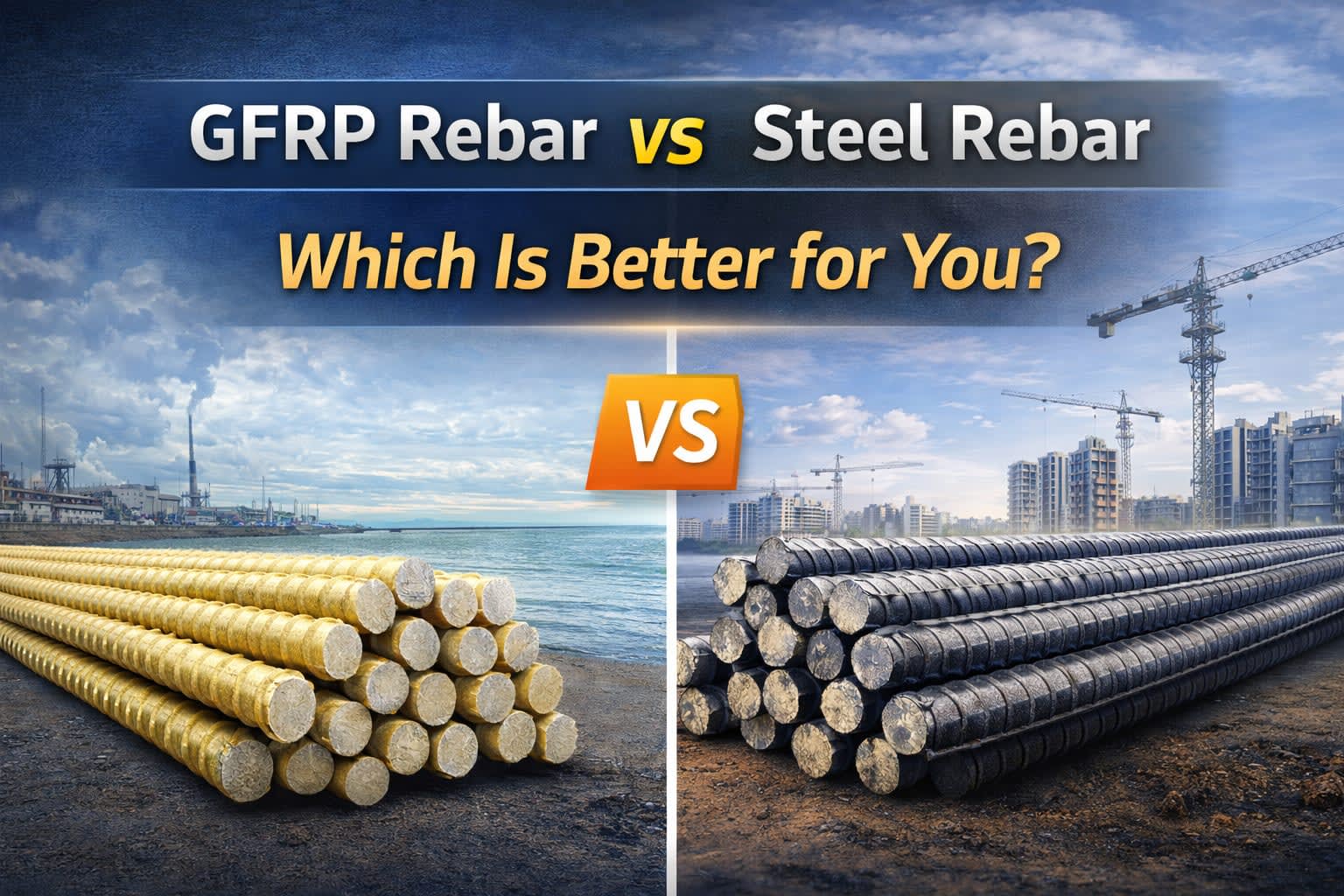
Choosing the right reinforcement material is one of the most critical decisions in any construction project. For decades, steel rebar has been the default choice. However, with advancements in construction technology, GFRP rebar (Glass Fiber Reinforced Polymer) is rapidly emerging as a strong alternative.
Builders, engineers, and developers are now asking an important question: GFRP rebar vs steel rebar— which is better for your project?
The answer depends on multiple factors, including durability, environment, cost, load requirements, and long-term performance. This blog offers a detailed and practical comparison to help you make an informed decision.
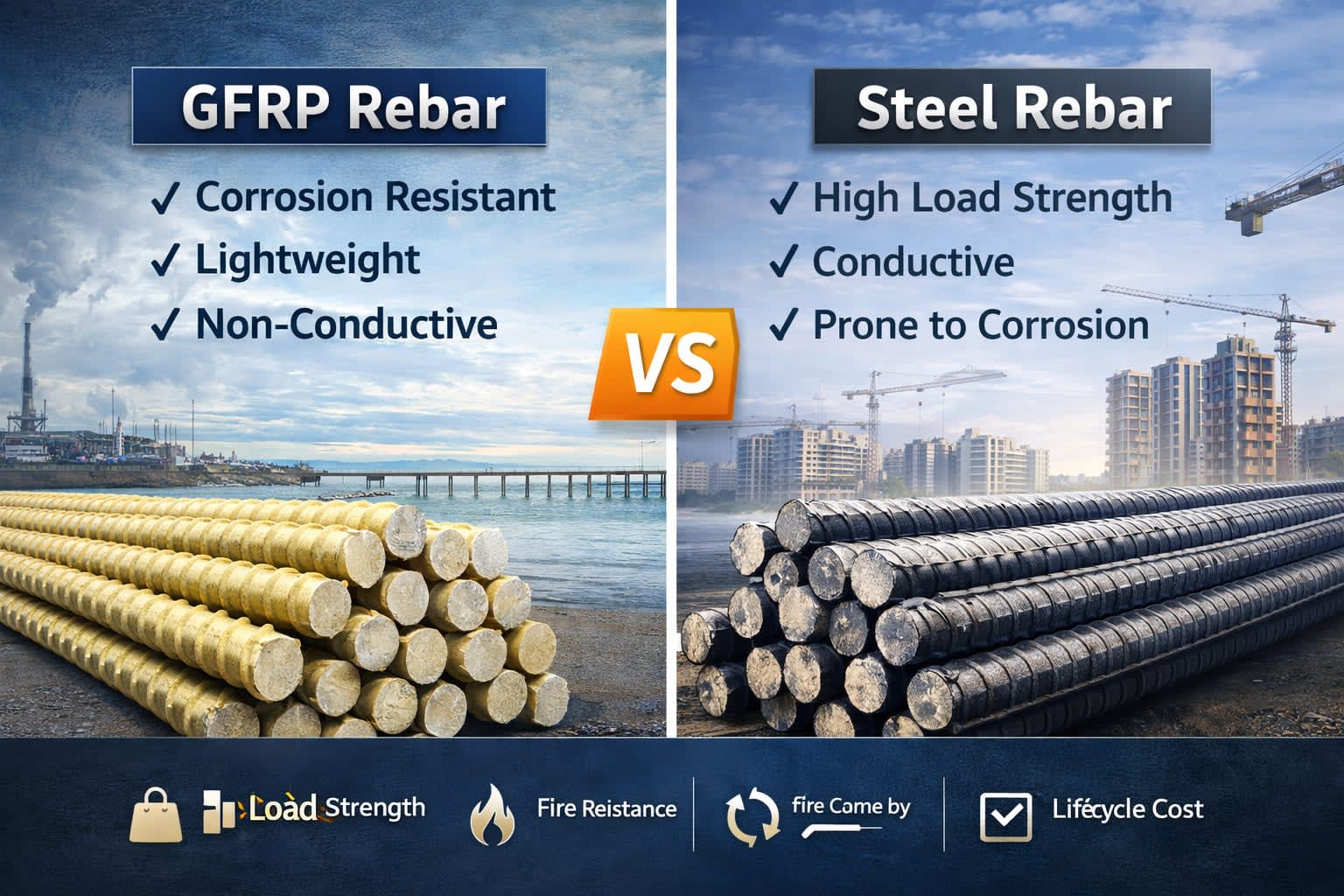
Understanding Rebar and Its Role in Construction
Rebar (reinforcing bar) is used to:
- Strengthen concrete structures
- Improve tensile strength
- Enhance durability and load-bearing capacity
Concrete is strong in compression but weak in tension—rebar solves this problem.
Traditionally, steel has dominated this role, but newer materials like GFRP are changing how modern structures are built.
What Is Steel Rebar?
Steel rebar is made from carbon steel and is widely used across residential, commercial, and infrastructure projects.
Key Characteristics of Steel Rebar
- High tensile strength
- Good ductility
- Familiar to contractors and engineers
Steel rebar commonly complies with IS 1786, which defines grades like Fe 415, Fe 500, and Fe 500D.
What Is GFRP Rebar?
GFRP rebar is manufactured using glass fibers embedded in a polymer resin matrix. Unlike steel, it is completely non-metallic.
Key Characteristics of GFRP Rebar
- Extremely corrosion-resistant
- Lightweight
- Non-conductive and non-magnetic
- High tensile strength but lower modulus of elasticity
GFRP rebar is increasingly used in:
- Coastal structures
- Chemical plants
- Bridges
- Marine and water-treatment projects
- Industrial shed
- Poultry farm
- Cold storage
- Etp/stp
- Swimming pool
- Boundry walls
- Roads
GFRP Rebar vs Steel Rebar: A Detailed Comparison
Let’s compare both materials across key parameters that matter in real-world construction.
1. Strength and Load Performance
Steel Rebar
- Excellent yield strength
- Performs well under heavy structural loads
- Highly ductile, giving a warning before failure
GFRP Rebar
- Higher tensile strength than steel
- Linear elastic behavior (no yielding before failure)
- Lower modulus of elasticity than steel
Verdict: Steel is better for high-load and seismic structures, while GFRP works well where corrosion resistance is the priority.
2. Corrosion Resistance
Steel Rebar
- Prone to rust and corrosion
- Requires coatings or additional cover in aggressive environments
- Corrosion leads to cracking and spalling of concrete
GFRP Rebar
- 100% corrosion-resistant
- Ideal for coastal, marine, and chemical environments
- Extends the structure's lifespan significantly
Verdict: GFRP rebar clearly outperforms steel in corrosive conditions.
3. Weight and Handling
Steel Rebar
- Heavy
- Higher transportation and labor costs
- Requires machinery for handling large quantities
GFRP Rebar
- About 75% lighter than steel
- Easier to transport and install
- Reduces on-site labor effort
Verdict: GFRP rebar is more efficient for handling and logistics.
4. Durability and Service Life
Steel Rebar
- Service life depends heavily on environmental conditions
- Requires maintenance and repairs over time
GFRP Rebar
- Resistant to moisture, chemicals, and salts
- Minimal maintenance
- Longer service life in harsh environments
Verdict: For long-term durability, GFRP has a strong advantage.
5. Cost Comparison (Short-Term vs Long-Term)
Steel Rebar
- Lower initial material cost
- Widely available from rebar manufacturers in India
- Higher lifecycle maintenance cost
GFRP Rebar
- Higher upfront cost
- Lower maintenance and repair expenses
- Better long-term value in aggressive environments
Verdict: Steel is cost-effective initially; GFRP is cost-effective over the structure’s lifetime.
6. Fire Resistance
Steel Rebar
- Maintains strength at high temperatures
- Performs well in fire-rated structures
GFRP Rebar
- The polymer matrix can degrade under extreme heat
- Requires special fire design considerations
Verdict: Steel rebar is better for fire-prone or fire-rated structures.
7. Electrical and Magnetic Properties
Steel Rebar
- Conductive
- Magnetic
- Can interfere with sensitive equipment
GFRP Rebar
- Non-conductive
- Non-magnetic
- Ideal for hospitals, laboratories, and power plants
Verdict: GFRP is superior for specialized technical environments.
8. Environmental Impact
Steel Rebar
- Energy-intensive manufacturing
- Recyclable but with a high carbon footprint
GFRP Rebar
- Lower maintenance-related emissions
- Longer lifespan reduces material replacement
Verdict: GFRP offers better sustainability over time.
When Should You Choose Steel Rebar?
Steel rebar is the better choice when:
- High load-bearing capacity is required
- Fire resistance is critical
- Budget constraints are tight
- Conventional design codes apply
It remains the most widely used option supported by experienced contractors and structural engineers.
When Should You Choose GFRP Rebar?
GFRP rebar is ideal when:
- Corrosion is a major concern
- The structure is in coastal or chemical environments
- Lightweight construction is preferred
- Long service life is a priority
Many modern infrastructure projects are now adopting GFRP for these reasons.
Availability and Sourcing in India
Steel rebar is easily available through established rebar manufacturers in India, while GFRP rebar is still an emerging but fast-growing segment.
When sourcing either material, always ensure:
- Compliance with standards
- Technical documentation
- Engineering approval
Trusted platforms like RebarX help simplify procurement by offering verified products and transparent specifications.
Common Mistakes to Avoid When Choosing Rebar
- Selecting material based only on price
- Ignoring environmental exposure
- Not consulting a structural engineer
- Overlooking lifecycle costs
- Using non-certified products
Avoiding these mistakes ensures safety and long-term performance.
Conclusion
The debate of vs steel rebar does not have a one-size-fits-all answer. Steel rebar continues to dominate conventional construction due to its strength, ductility, and affordability. However, GFRP rebar is rapidly proving its value in corrosion-prone, specialized, and long-life structures.
The right choice depends on project requirements, environment, budget, and long-term performance goals. By understanding the strengths and limitations of both materials, you can make a confident, future-ready decision.
Frequently Asked Questions (FAQs)
1. Is GFRP rebar stronger than steel rebar?
GFRP rebar has higher tensile strength, but steel has better ductility and stiffness.
2. Can GFRP rebar replace steel rebar completely?
Not in all applications. Steel is still preferred for high-load and fire-rated structures.
3. Is GFRP rebar approved for use in India?
Yes, it is used in specialized projects, but adoption depends on design standards and approvals.
4. Which rebar lasts longer—steel or GFRP?
GFRP rebar generally lasts longer in corrosive environments due to its non-metallic nature.
5. Is GFRP rebar cost-effective?
While the initial cost is higher, GFRP offers lower lifecycle costs in harsh environments.