For decades, steel rebar has been the backbone of construction. It's strong, familiar, and seemingly reliable. But what if we told you that the very material holding our structures together is often their greatest weakness, especially in the long run? And what if there's a modern alternative that's not just better, but truly revolutionary for sustainable construction?
At RebarX, we believe in building for the future. That's why we're championing Glass Fiber Reinforced Polymer (GFRP) rebars, and here's why these non-corrosive rebars are set to replace traditional steel as the reinforcement of choice.
The Hidden Weakness of Steel: A Costly Problem for Infrastructure
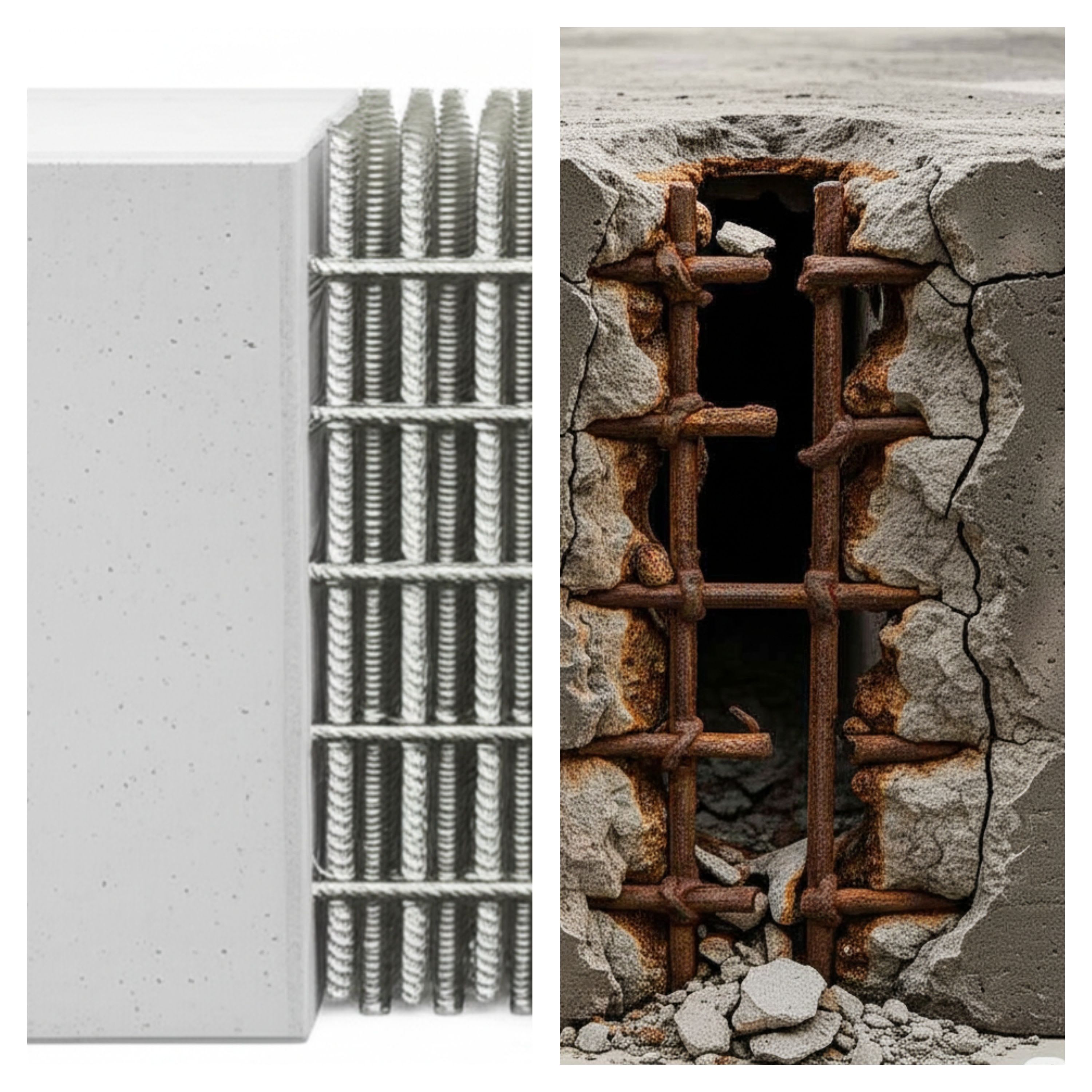
The biggest Achilles' heel of steel rebar is its susceptibility to corrosion. When moisture, chlorides (from de-icing salts, coastal air, or even contaminated soil), or aggressive chemicals penetrate concrete, they reach the steel, causing it to rust. This rebar corrosion expands, leading to:
-Cracking and Spalling: The expanding rust puts immense pressure on the surrounding concrete, causing it to crack and break away. This isn't just an aesthetic issue; it compromises the structural integrity of the entire building.
-Reduced Lifespan: Structures reinforced with corrosive steel in harsh environments often have a significantly shorter service life, leading to expensive and disruptive repairs, or even premature demolition and replacement.
-High Maintenance Costs: Constant monitoring, patching, and rehabilitation are required to keep corroding steel structures safe, draining budgets over time.
This isn't just theory. Consider the ongoing challenges faced by coastal bridges or structures in areas with heavy salt use – steel's vulnerability is a widespread and costly problem for concrete reinforcement.
GFRP Rebar: Unmatched Advantages for Future-Proof Structures
Now, let's talk about the game-changer: GFRP rebar. Engineered from high-strength glass fibers and a durable polymer resin, GFRP eliminates steel's fundamental flaws while introducing a host of new benefits for modern construction materials:
Absolute Corrosion Immunity: GFRP simply does not rust. This is its most significant advantage, ensuring the longevity and structural integrity of concrete without the threat of expansion, cracking, or spalling.
-Real-World Impact: The Jizan Flood Mitigation Channel in Saudi Arabia, a monumental 21.3 km project, utilized over 10 million linear meters of GFRP bars. This ensures a design life of 100 years with minimal maintenance, vital for protecting critical infrastructure in a harsh, corrosive environment. This project stands as the world's largest GFRP rebar application, a testament to its reliability.
Lightweight & Efficient: GFRP is significantly lighter than steel – up to four times lighter! This translates directly into:
-Reduced Transportation Costs: Less weight means more material per shipment.
-Faster Installation: Easier handling on-site, requiring less heavy machinery and labor.
-Lower Foundation Loads: Beneficial for multi-story buildings where overall weight is a design consideration.
Global Recognition: Even iconic structures like the Burj Khalifa in Dubai incorporate GFRP (and similar FRPs like Basalt Fiber Reinforced Polymer for elements like internal cladding panels), leveraging its benefits for structural integrity and resistance to harsh climates.
-Non-Magnetic & Non-Conductive: Unlike steel, GFRP doesn't interfere with electromagnetic fields or conduct electricity.
Critical Application: This property makes GFRP the standard reinforcement for MRI rooms in hospitals worldwide. Its use ensures that the powerful magnetic fields of MRI machines operate without interference, guaranteeing accurate diagnostic imaging and patient safety.
Proven Performance in Buildings: While often highlighted in infrastructure,
GFRP's benefits extend to residential and commercial buildings:
-The Krasnoyarsk Multi-Story Building in Russia is a documented example of GFRP reinforcement in a multi-story residential context, demonstrating its viability beyond traditional infrastructure.
-Historically, the "House of the Future" at Disneyland (USA, 1956) was an early, experimental residential structure built primarily with polymer fiberglass. Famously, "wrecking balls bounced off the fiberglass walls" during its demolition, highlighting the material's unexpected durability even decades ago.
Build Smarter, Build to Last with RebarX
Choosing GFRP rebar means investing in a future where your structures are stronger, safer, and more sustainable. You eliminate the hidden costs of corrosion and embrace a building material that offers unparalleled longevity and performance.
Ready to make the smart switch? Contact RebarX today to learn how GFRP rebars can elevate your next construction project.