
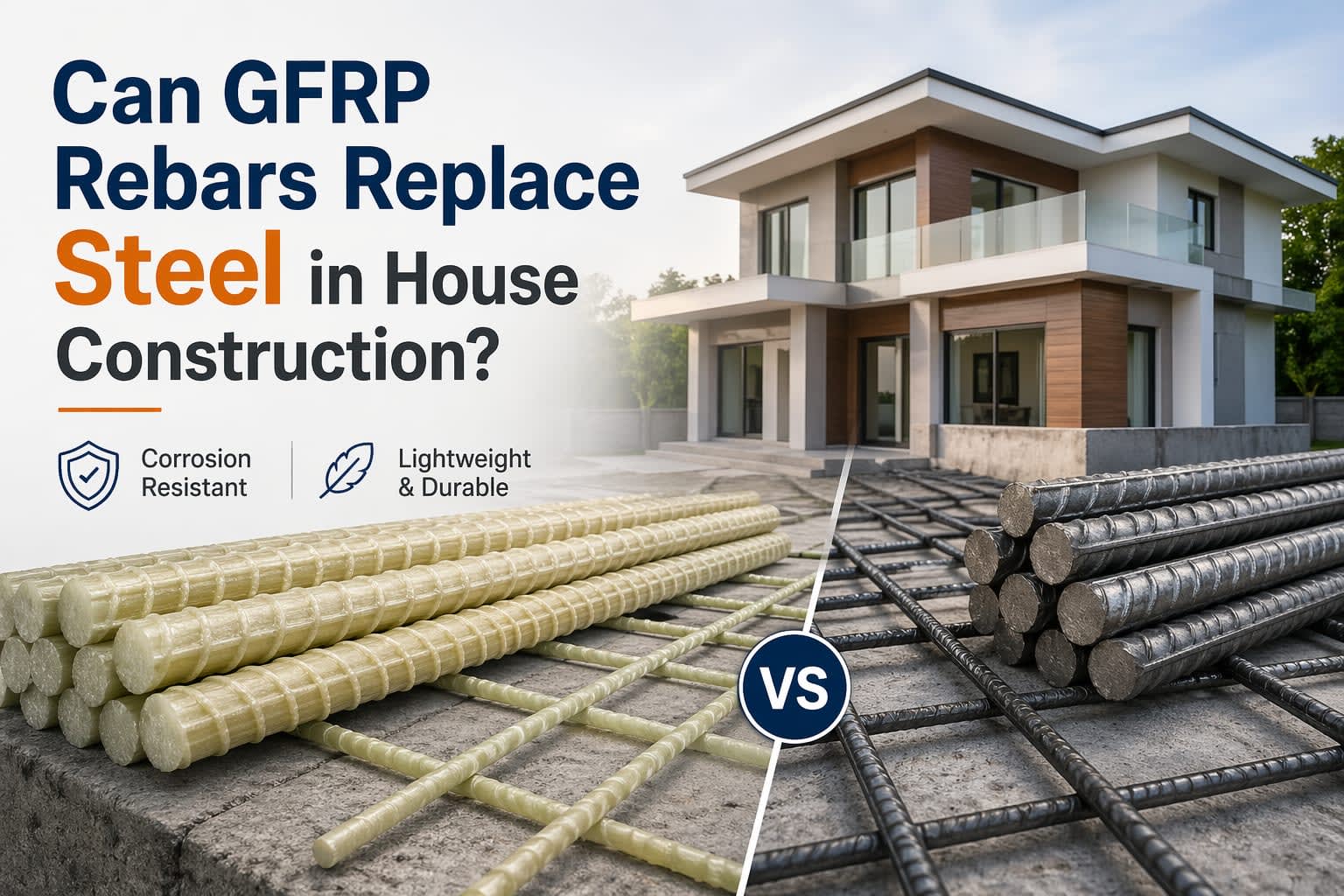
Introduction
For decades, steel has been the default choice for house construction. From foundations to slabs, it has been trusted for its strength and familiarity.
But construction today is changing. Homeowners and builders are starting to look beyond just strength and are asking more practical questions:
Will the structure last longer?Will it require maintenance later?Is there a smarter material choice available today?
This is where GFRP (Glass Fiber Reinforced Polymer) rebars are entering the conversation.
What Makes House Construction Different
Unlike large infrastructure projects, house construction is more sensitive to long-term issues such as cracks, leaks, and maintenance needs.
A small crack in a residential structure can quickly turn into:
- Water seepage
- Damp walls
- Structural discomfort
- Repeated repair costs
Most of these problems are not caused by poor construction, but by how materials behave over time.
The Limitations of Steel in Homes
Steel performs well initially, but its long-term behavior in certain conditions creates challenges.
Over time, moisture from the environment or water seepage can reach the reinforcement inside the concrete. When that happens, corrosion begins.
As steel corrodes, it expands. This expansion creates internal stress, which leads to cracks in the concrete. These cracks may appear small at first, but they often grow and lead to recurring maintenance issues.
In residential construction, where comfort and durability matter, this becomes a major concern.
How GFRP Changes the Approach
GFRP rebars behave differently inside concrete.
Instead of reacting to moisture or environmental conditions, they remain stable over time. There is no internal expansion and no gradual weakening due to corrosion.
This helps maintain the structure's integrity and reduces the likelihood of cracks forming due to material behavior.
In simple terms, it allows the structure to perform consistently without creating hidden problems later.
Can GFRP Fully Replace Steel in House Construction?
The answer is: in many cases, yes—but it depends on how it is used.
GFRP can be effectively used in:
- Plinth Slabs & Plinth Beam
- Boundary
- Water tanks and underground structures
However, like any material, it requires proper design planning. It behaves differently from steel, so engineers need to account for those properties during structural design.
This is not a limitation—it’s simply a different approach.
What Changes During Construction
One of the practical advantages of GFRP becomes visible during execution.
Since it is lighter than steel, it is easier to transport, handle, and place. This reduces effort on-site and helps speed up construction.
In many cases, this also improves overall efficiency during the building process.
A Simple Cost Comparison
GFRP rebars are generally more economical than steel, making them a practical option for residential construction.
Instead of just focusing on initial material selection, many homeowners today are considering how the structure will perform over time—and GFRP fits well with that thinking.
Where It Makes the Most Sense in Homes
While GFRP can be used across different parts of a house, it becomes especially valuable in areas where moisture exposure is higher.
This includes:
- Basements
- Water tanks
- Bathrooms and wet areas
In such spaces, using a material that remains stable over time helps avoid future issues.
Things to Keep in Mind
GFRP is not about replacing steel blindly—it’s about using the right material in the right way.
Proper design, correct installation, and understanding of the material are important to get the best results.
As awareness increases, more engineers and builders are becoming comfortable working with it.
Final Thoughts
Steel has been the standard in-house construction for years, mainly because it is familiar and widely available. But familiarity does not always mean it is the best choice for every situation. GFRP rebars offer a more stable and reliable option, especially in conditions where long-term performance matters. They reduce the chances of internal damage, improve durability, and simplify maintenance over time. For modern home construction, this makes them not just an alternative—but a smart and practical choice, which is why many builders today prefer working with trusted .
FAQs
1. Can GFRP rebars be used in residential construction?
Yes, they can be used in various parts of a house with proper design.
2. Are GFRP rebars stronger than steel?
They have high tensile strength but behave differently, so design adjustments are required.
3. Do GFRP rebars corrode?
No, they are completely resistant to corrosion.
4. Is GFRP more economical than steel?
Yes, GFRP rebars are generally more cost-effective than steel.
5. Where should GFRP be used in a house?
They are especially useful in Plinth slab, water tanks, basements, and moisture-prone areas.