
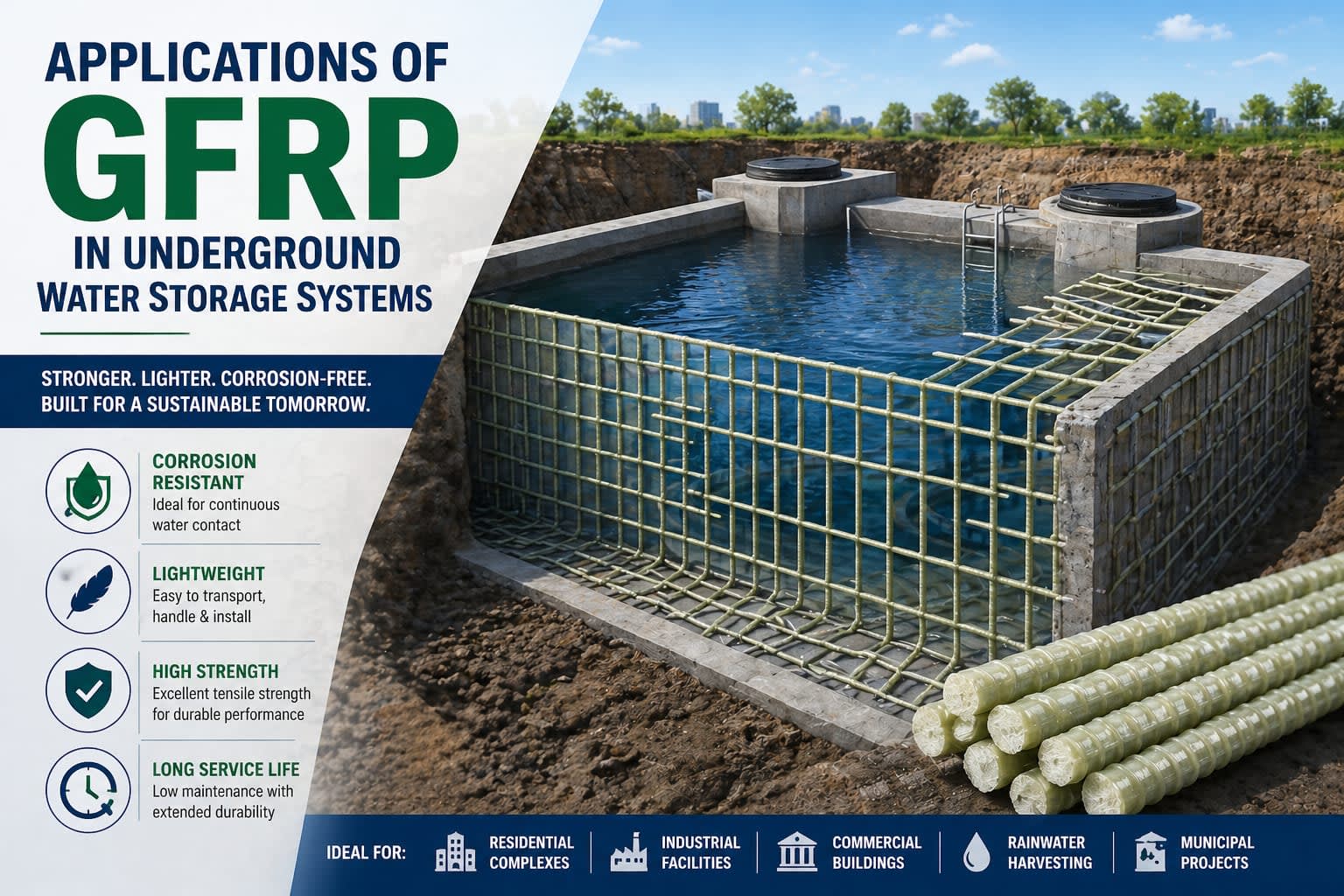
Why Underground Structures Demand a Different Approach
Underground water storage systems are some of the most overlooked yet critical components of infrastructure. Once constructed, they are expected to function reliably for decades—without easy access for inspection or repair.
Unlike above-ground structures, these systems are constantly exposed to moisture from all directions. Water exists not only inside the structure but also in the surrounding soil. Add to that the presence of chemicals, fluctuating pressure, and biological activity, and you get an environment that is far more aggressive than it appears on the surface.
This is exactly where traditional material choices begin to fall short, which is why many engineers today are exploring better solutions from trusted .
The Hidden Problem with Steel in Underground Water Systems
For years, steel has been the default reinforcement material. It performs well in many environments, but underground water systems expose its biggest weakness—corrosion.
Concrete, despite being strong, is not completely impermeable. Over time, moisture and chemicals penetrate through micro-cracks and pores. When they reach the steel reinforcement, corrosion begins.
This process is slow but destructive. As steel rusts, it expands. This expansion creates internal pressure within the concrete, eventually leading to cracks, spalling, and in many cases, leakage.
What makes this even more problematic is that the damage starts internally. By the time visible signs appear, the structure has already been compromised.
Why GFRP is Fundamentally Different
GFRP (Glass Fiber Reinforced Polymer) rebars change this equation entirely because they are non-metallic. Unlike steel, they do not react with water, oxygen, or chemicals. This means the primary cause of structural deterioration—corrosion—is eliminated from the beginning.
But the real advantage of GFRP is not just technical. It is practical.
Instead of designing a system that will eventually require repairs, GFRP allows engineers to design structures that maintain their integrity over time, even in aggressive underground conditions.
Application 1: Underground Water Storage Tanks
In underground tanks, the reinforcement is continuously exposed to moisture from both inside and outside. Steel in such conditions inevitably begins to deteriorate, which can lead to cracks and water leakage over time.
When GFRP rebars are used instead, this risk is significantly reduced. Since the material does not corrode, the internal structure remains stable, and the chances of cracking due to rust expansion are eliminated.
This directly translates into longer service life and fewer maintenance concerns.
Application 2: Inspection Chambers and Underground Pipelines
Underground chambers and pipelines operate in highly confined and moisture-rich environments. They are also frequently exposed to chemicals, especially in sewage and wastewater systems.
In such conditions, steel reinforcement requires ongoing monitoring and protection. GFRP, however, performs consistently without degradation. It does not require additional coatings or protective treatments, which simplifies both construction and long-term maintenance.
Application 3: Waterproof and Water-Retaining Structures
Water-retaining structures demand high levels of integrity. Even small cracks can lead to leakage, which can compromise the entire system.
One of the biggest causes of cracking in such structures is the expansion of corroded steel. Since GFRP does not rust, this issue is completely avoided. The concrete remains intact, and the structure retains its waterproofing capability for a much longer period.
Application 4: Foundations in High Water Table Areas
In areas with high groundwater levels, foundations are constantly exposed to moisture. Steel reinforcement in such conditions is highly susceptible to corrosion, which can weaken the structural base over time.
GFRP provides a reliable alternative here. Its resistance to water and chemicals ensures that the foundation remains structurally sound, even in continuously saturated conditions.
Application 5: Drinking Water Storage Systems
When it comes to potable water storage, material safety becomes a priority. Any corrosion or material degradation can potentially affect water quality.
GFRP is non-toxic and non-reactive, making it suitable for such applications. It does not introduce contaminants into the water and helps maintain hygiene standards over long periods.
Cost Perspective: The Practical Reality on Site
GFRP rebars are lightweight, making them easier to handle and quicker to install. This helps reduce labor, transportation, and overall construction time.
Instead of only looking at price per kilogram, it’s better to consider total cost—including material, labor, and efficiency.
When these factors are combined, GFRP can be cost-effective from the outset. Plus, since it doesn’t corrode, it avoids future repair and maintenance costs.
A More Practical Way to Think About Material Selection
In underground construction, the biggest risks are often invisible. You cannot easily monitor internal reinforcement, and repairs are costly and disruptive.
This is why material selection should focus not only on strength, but on how the material behaves over time in real conditions.
GFRP aligns with this approach by addressing the root cause of failure rather than managing its consequences.
Conclusion: Building for Longevity, Not Just Completion
Underground water storage systems are expected to perform quietly and reliably for decades. But achieving that level of performance requires more than just good design—it requires the right materials.
Steel, while familiar, introduces long-term risks in moisture-heavy environments. GFRP removes those risks entirely.
By choosing GFRP, engineers are not just improving durability—they are simplifying maintenance, reducing future repair costs, and ensuring consistent performance.
And in underground structures, where access is limited and failure is costly, that difference matters more than anything.
FAQs
1. Why is GFRP better for underground water systems?
Because it does not corrode, making it ideal for environments with constant moisture and chemical exposure.
2. Does GFRP improve the lifespan of structures?
Yes, it helps maintain structural integrity for a much longer period than steel in corrosive environments.
3. Is GFRP safe for drinking water storage?
Yes, it is non-toxic and does not affect water quality.
4. Is GFRP cost-effective?
Yes, it is cost-effective from the start and also eliminates future repair and maintenance costs.