
Introduction
Infrastructure today demands more than just strength — it demands durability, corrosion resistance, long service life, and lower lifecycle costs. Traditional steel reinforcement has served the industry for decades, but its vulnerability to corrosion, especially in aggressive environments, has led engineers to explore better alternatives.
Glass Fibre Reinforced Polymer (GFRP) is now redefining modern construction. From bridges and flyovers to coastal infrastructure, glass fibre reinforcement bars are rapidly becoming the preferred choice for forward-thinking engineers and developers.
At Rebarx, we specialize in manufacturing high-performance GFRP solutions designed for durability-critical projects across India.
Why GFRP is Transforming Infrastructure Construction
Before diving into specific applications, it’s important to understand why GFRP is gaining traction:
- 100% corrosion resistant
- High strength-to-weight ratio
- Electrically non-conductive
- Low maintenance requirements
- Extended service life
Compared to conventional steel, high strength reinforcement bars made from GFRP offer superior performance in harsh environmental conditions.
Applications of GFRP in Bridges
1. Bridge Deck Reinforcement
Bridge decks are constantly exposed to:
- Rainwate
- De-icing salts
- Temperature variations
- Traffic-induced stress
Steel reinforcement corrodes when exposed to chlorides, leading to cracking and structural deterioration. In contrast, glass fibre reinforcement bars are completely resistant to corrosion.
Using GFRP in bridge decks:
- Prevents rust-related expansion
- Reduces maintenance cycles
- Extends structural lifespan
- Improves load durability
Many modern infrastructure projects are now incorporating GFRP to achieve 75–100 years of design life.
2. Bridge Barriers and Parapets
Crash barriers and side parapets are vulnerable to weather and impact stress. GFRP reinforcement ensures:
- Higher durability
- Reduced structural weight
- Long-term stability
Its lightweight nature also makes handling and installation easier, reducing labor costs.
3. Precast Bridge Components
Precast girders, panels, and slabs reinforced with GFRP:
- Reduce transportation weight
- Improve construction speed
- Lower installation time
Leading rebar manufacturers in India are now supplying customized GFRP solutions for precast infrastructure projects.
Applications of GFRP in Flyovers
Flyovers in urban India face continuous environmental and traffic stress. Pollution, moisture, and vibration accelerate steel corrosion.
1. Elevated Slabs and Decks
Using high strength reinforcement bars made from GFRP in flyover decks ensures:
- No corrosion even in polluted environments
- Reduced long-term repair costs
- Improved structural stability
Since GFRP is lighter than steel, it also reduces the dead load on columns and foundations.
2. Expansion Joints and Approach Slabs
Areas near expansion joints are highly susceptible to water seepage. GFRP prevents deterioration caused by water ingress and chloride attack.
This is especially beneficial in metro cities where flyovers are exposed to extreme environmental conditions.
3. Reduced Maintenance in High-Traffic Zones
Repairing flyovers causes traffic disruption and economic losses. GFRP reinforcement significantly reduces the frequency of maintenance interventions.
For government infrastructure bodies and EPC contractors, this translates into:
- Lower lifecycle cost
- Improved project ROI
- Increased public safety
Applications of GFRP in Coastal Structures
Coastal environments are the harshest for reinforced concrete. Salt-laden air and seawater accelerate steel corrosion rapidly.
1. Sea Walls and Retaining Structures
Saltwater penetration leads to severe steel corrosion. GFRP eliminates this issue.
Using glass fibre reinforcement bars in:
- Sea walls
- Breakwaters
- Retaining walls
- Harbor structures
ensures long-term structural integrity even in continuous salt exposure.
2. Piers and Jetty Structures
Marine structures are constantly submerged or splashed by seawater. GFRP reinforcement:
- Resists chloride attack
- Prevents rust expansion
- Maintains concrete integrity
This makes it an ideal solution for ports, fishing harbors, and industrial marine facilities.
3. Coastal Road Infrastructure
Bridges and flyovers near coastlines deteriorate faster due to saline air. Using GFRP significantly increases durability and reduces rehabilitation frequency.
Infrastructure planners now prefer sourcing from reliable rebar manufacturers in India that provide certified GFRP solutions for marine conditions.
Technical Advantages Over Steel
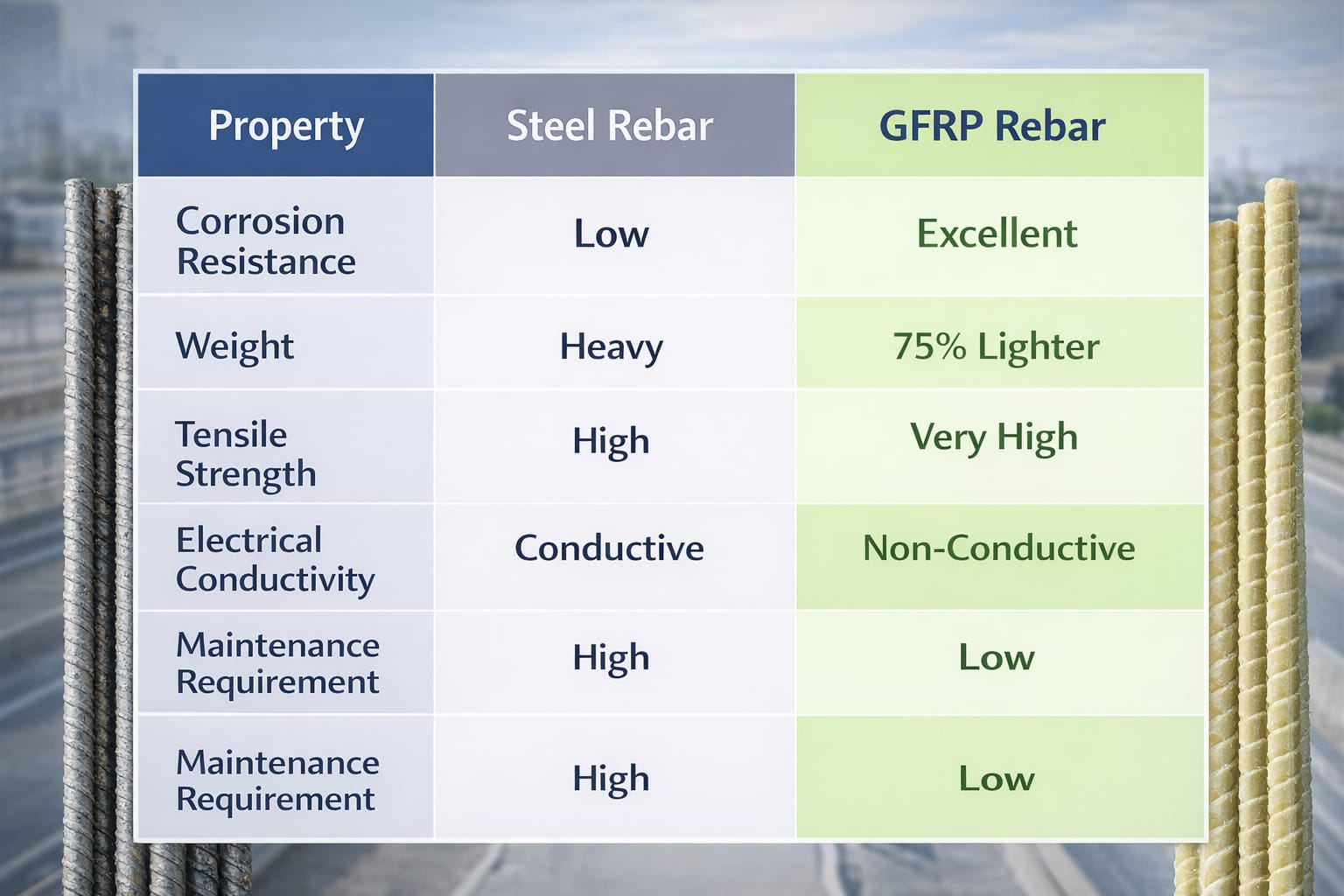
The long-term performance advantage clearly positions GFRP as the smarter choice for modern infrastructure.
Sustainability Benefits
Infrastructure projects today are judged not only on strength but also on sustainability.
GFRP contributes to:
- Reduced material replacement
- Lower carbon footprint over the lifecycle
- Extended infrastructure lifespan
- Reduced resource consumption
For government and private infrastructure developers, this aligns with long-term sustainability goals.
Why Choose Rebarx for GFRP Solutions?
At Rebarx, we manufacture premium-quality glass fibre reinforcement bars engineered for critical infrastructure applications.
Our key strengths:
- Advanced manufacturing technology
- Consistent tensile strength performance
- Custom sizing options
- Strict quality testing standards
- Reliable supply chain across India
As one of the leading rebar manufacturers in India, Rebarx is committed to delivering durable, high-strength reinforcement bars that meet global standards.
Conclusion
Bridges, flyovers, and coastal structures demand materials that can withstand the test of time, traffic, and environmental stress. Traditional steel reinforcement, while strong, cannot match the corrosion resistance and lifecycle advantages offered by GFRP.
With superior strength, reduced maintenance needs, and unmatched durability in aggressive environments, glass fibre reinforcement bars are reshaping India’s infrastructure landscape.
For infrastructure projects that demand long-term performance and reliability, Rebarx delivers engineered GFRP solutions you can trust.
Frequently Asked Questions (FAQs)
1. Is GFRP stronger than steel for bridges?
GFRP offers higher tensile strength than steel and superior corrosion resistance, making it ideal for bridge applications.
2. Can GFRP be used in marine and coastal areas?
Yes. GFRP is completely resistant to saltwater corrosion, making it ideal for coastal and marine structures.
3. Are glass fibre reinforcement bars cost-effective?
While initial costs may vary, GFRP significantly reduces lifecycle maintenance expenses.
4. Do flyovers benefit from GFRP reinforcement?
Yes. GFRP enhances durability, reduces dead load, and minimizes repair frequency in flyover structures.
5. Why choose Rebarx for GFRP solutions?
Rebarx provides high-performance, quality-tested GFRP reinforcement bars tailored for infrastructure applications across India.